

The Three-Pass Shave
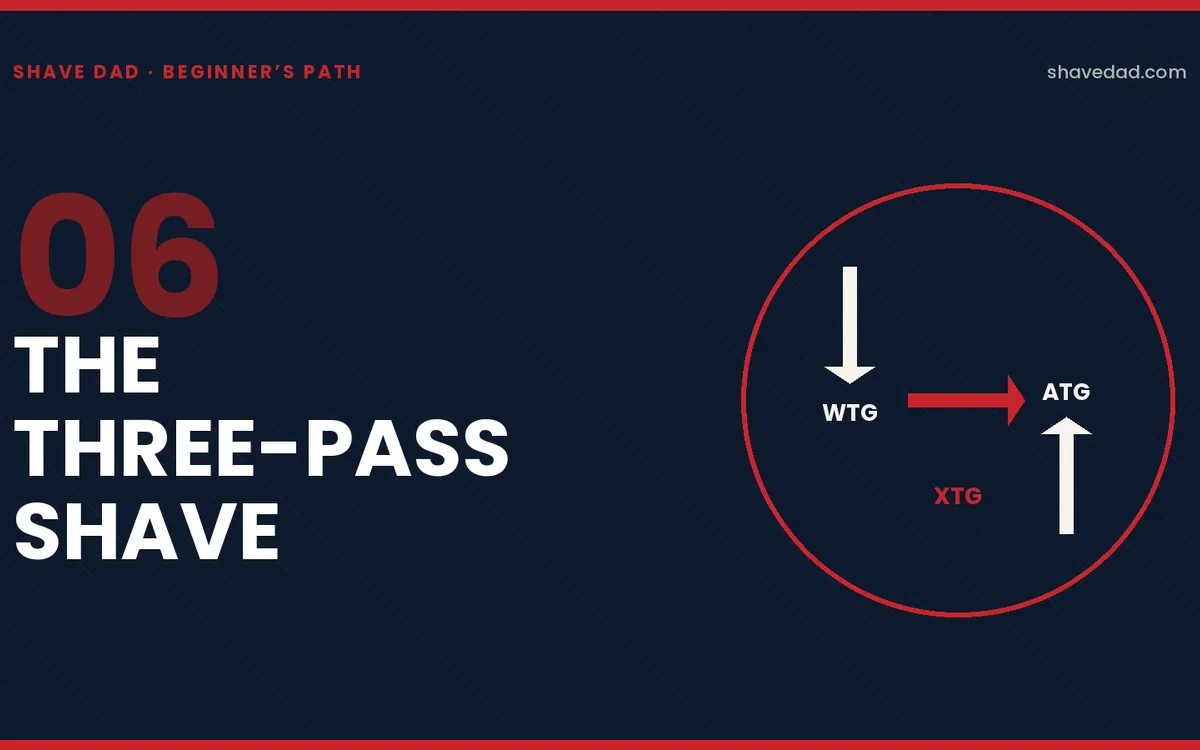
WTG, XTG, ATG, what they mean, why each pass exists, and how to actually do them without bleeding.
What it is
Wet shavers don’t try to remove all the stubble in one pass. We do it in three light passes, each at a different angle to the grain. Each pass takes off part of the hair. The end result is closer than a single hard pass and dramatically less irritating.
The grain map
“Grain” is the direction your beard hair grows. It is not the same on every part of your face. Many people find (yours may differ):
- Cheeks: hair growing downward (so WTG = downward stroke)
- Upper neck: hair growing diagonally
- Lower neck: often growing UPWARD or sideways (this is why people get neck irritation, they shave “down” thinking it’s WTG when it’s actually ATG)
- Chin: often a swirl that goes multiple directions
- Upper lip: usually downward
With two or three days of growth, run a fingertip over the stubble in each direction. The way that feels smooth is with the grain; the way that feels rough is against it. Map it once. Don’t guess.
Why three passes (not one big aggressive shave)
A single aggressive pass is what cartridge razors do, and many shavers find a single hard pass with a multi-blade cartridge more irritating. With a DE, three light passes at different angles let each pass remove its share of stubble cleanly with no drag.
It also lets you stop early. Many beginners do WTG only for the first month, that alone is comfortable and irritates less for many people, though it’s usually a little less close than a cartridge. Add XTG when WTG feels boring. Add ATG when XTG isn’t enough. There’s no rush.
The pass count is also a function of the blade you have loaded. Sharper blades cut more hair per pass and let some faces stop after two, while milder blades reward the third pass with a closer finish. Our DE blade sharpness ladder organizes twelve popular blades by sharpness so you can see how a rung change might change the shave you already know.
Beginner’s mistakes
- Pressing the razor into your face. No. Use the weight of the razor only. If you catch yourself pressing, check your angle first; a worn blade or thin lather can make you press too.
- Shaving too dry. Re-lather between passes. Always. Lather is the lubricant.
- Going ATG on day one. Don’t. Earn it.
- Going over the same stroke twice in one pass. Each spot of skin gets the blade exactly once per pass. If you missed a spot, leave it for the next pass.
- Death-gripping the razor. Loose grip. Three fingers. Let the razor swing into the right angle on its own.
How long it should take
A full three-pass shave with DE = ~10 minutes once you have the technique. The first week it’ll be 15-20. That’s normal. Don’t shave fast, wet shaving rewards patience the way no other grooming routine does.
Frequently asked questions
What are the three passes in a three-pass shave?
With the grain, across the grain, and against the grain, in that order. Each pass takes off part of the hair, at a different angle. Three light passes finish closer than one hard pass and irritate far less.
How do I find the grain of my beard?
With two or three days of growth, run a fingertip over the stubble in each direction. The way that feels smooth is with the grain; the way that feels rough is against it. Grain is not the same everywhere: cheeks usually grow downward, the lower neck often grows upward or sideways, and the chin is frequently a swirl. Map it once rather than guessing.
Do I have to do all three passes?
No. Many beginners do with-the-grain only for the first month, and that alone is comfortable and irritates less for many people, though it is usually a little less close than a cartridge. Add the across-the-grain pass when the first one starts to feel easy, and the against-the-grain pass only when across is not enough.
How long should a three-pass shave take?
About ten minutes once your technique settles. In the first week expect 15 to 20, which is normal. Wet shaving rewards going slowly.
Sharp blades make a three-pass shave a quick ritual instead of a chore, shop blade samplers at TWSS →