

The DE Blade Sharpness Ladder: From Butter Knife to Feather
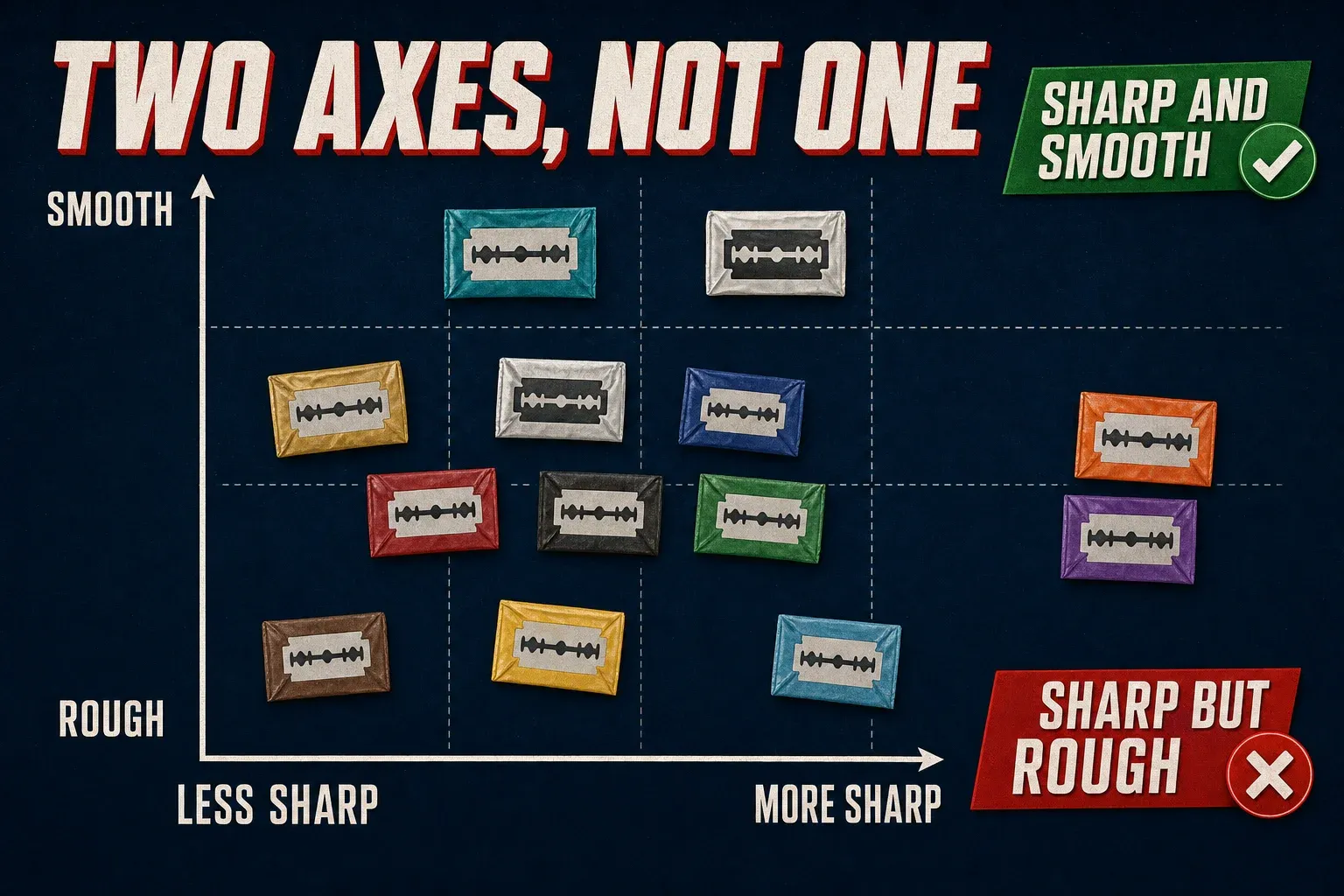
Ask a new DE shaver which blade to buy and the internet will give them fifteen answers, none of which agree. That is because most blade advice bundles two very different questions into one word: how sharp is it, and how smooth is it? Those are not the same thing. Feather Hi-Stainless is the sharpest common DE blade and also the least forgiving one. Astra Superior Platinum is not the sharpest, and is one of the most comfortable in wide rotation. Both are correct answers to different questions.
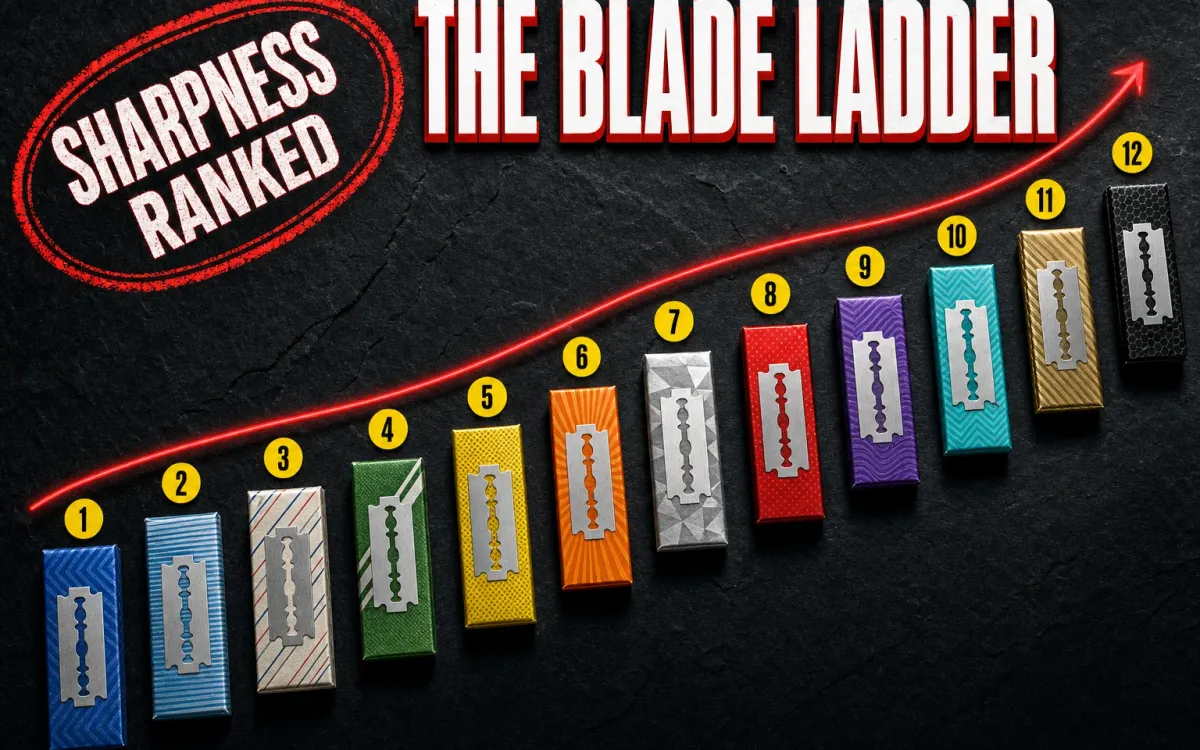
This post organizes twelve popular blades onto a single axis: sharpness. Rung 1 is the mildest daily driver in the sampler pack. Rung 12 is the sharpest blade in wide use. The ladder is not a ranking of “best.” It is a progression. Start where your face is right now. Climb when your technique catches up.
What “Sharp” and “Smooth” Actually Mean
Sharpness is cutting force. A sharper blade removes more hair per pass under less pressure. If you feel like you need three passes to get a clean shave and your blade is not new, you are probably too low on the ladder for your beard.
Smoothness is what the edge feels like as it crosses skin. That comes from a mix of coating (PTFE, chromium, platinum), edge geometry, and grind consistency. A smooth blade glides. A rough blade grabs. Rough blades are why some shavers report “burn” on paper-sharp blades that other shavers love: the burn is not the sharpness cutting them, it is friction from an edge that will not slip.
The two axes correlate loosely up to about the middle of the ladder. Past that, they diverge. Feather is at the top of the sharpness axis and closer to the middle of the smoothness axis. Voskhod is closer to the middle of sharpness and near the top of smoothness. Which one is “better” depends on which axis your face cares about, not on the blade itself.
Why a Ladder and Not a Ranking
Skin adapts. A face that could not handle a Feather at week two of DE shaving will often handle one comfortably at month six, because technique has tightened and the skin has toughened. The same rotation blade can feel completely different in different seasons, on different hydration levels, and against beard growth that has actually changed since the last time you tried it.
That is why the ladder is a ladder. It is a shape you climb, not a scoreboard you pick from. Every rung is a legitimate destination for the right shaver. The person who lives at rung 3 and gets an irritation-free shave every day beats the person who forces a rung 11 blade past what their skin can take.
The Ladder
The rung numbers below are approximate community-consensus positions drawn from wet-shaving forum polls and long-running sampler comparisons. Individual faces will disagree with any specific ordering, and reasonable rankings from other places will move any given blade a rung or two in either direction. Small movements up or down are noise. Large movements (four rungs or more) are real signal.
Rung 1: Derby Extra
The classic “butter knife.” Mildest daily driver in common circulation, forgiving to bad technique, and inexpensive enough that a hundred-blade pack lasts close to two years for most shavers. If a rung-8 blade is drawing blood on your neck and you cannot figure out why, dropping to a Derby Extra for a week isolates whether the problem is the blade or the technique.
Rung 2: Personna Med Prep
Personna Med Prep is the medical-grade platinum-coated variant that some barbershops keep on hand for reactive skin. Very mild edge, smooth-riding, unremarkable in the best way. Common pairing with sensitive-skin shavers coming off cartridges.
Rung 3: Astra Superior Platinum (Green)
The Astra Green is the workhorse blade of the wet-shaving world. Slightly sharper than Derby and Personna Med Prep, still on the milder side of the middle, forgiving to most techniques, and priced low enough that a hundred-blade pack is a two-year supply for daily shavers. If you are switching from cartridges and asking “which blade first,” Astra Green is the correct default answer nine times out of ten.
Rung 4: Wilkinson Sword Classic
The Wilkinson Sword Classic is a mild-to-medium blade widely available at drugstores. Slightly sharper than the Astra Green in most rotations, still gentle, and cheap. Where you land relative to the Astra depends on your face; some shavers rate it above, some below.
Rung 5: Personna Lab Blue
The Personna Lab Blue is the American-made platinum-coated blade shipped in the blue-and-white pack. It sits right in the middle of the ladder: smooth, dependable, sharp enough for a comfortable two-pass shave without the “grab” some shavers report from cheaper stainless. A good next step for anyone who has run Astra Green for six months and is ready to test whether a little more edge helps.
Rung 6: BIC Chrome Platinum
The BIC Chrome Platinum is a divisive blade. Community sampler rankings put it in the upper-middle for sharpness, but reports on smoothness vary widely from face to face. Some shavers describe the first pass as slightly grabby before it settles; others land it above the Voskhod for comfort out of the box. The variance is why it sits in the middle of the ladder rather than higher.
Rung 7: Voskhod
The Voskhod is the smoothness benchmark of the middle-upper rungs. PTFE-coated, historically manufactured under the Russian Voskhod brand, and consistently rated as one of the smoothest mid-sharpness blades in wide rotation. If a mid-ladder shaver is looking for their permanent daily driver, the Voskhod is where a lot of them stop climbing.
Rung 8: Gillette Silver Blue
The Gillette Silver Blue, universally shortened to GSB in wet-shaving forums, is the community’s answer to “what if the Voskhod were a little sharper without giving up any of the smoothness.” Historically produced at Gillette’s St. Petersburg plant, platinum-coated, consistent batch to batch when in wide circulation. Landed as the daily driver for a huge percentage of intermediate DE shavers.
Rung 9: Gillette Nacet
The Gillette Nacet is the GSB’s sharper sibling. Same coating philosophy, sharper edge, comfortable enough that most shavers who love the GSB can climb to Nacet without incident. This is where the ladder starts to lean toward sharpness over smoothness.
Rung 10: Gillette 7 O’Clock Super Platinum (Black)
The Gillette 7 O’Clock Super Platinum, the black-pack variant, is what shavers reach for when the Nacet is no longer close enough for a two-pass shave. Sharp, still smooth, and popular in the vintage-razor rotation because the geometry rewards blades that hold an edge across the full plate.
Rung 11: Polsilver Iridium
The Polsilver Iridium sits near the top of the ladder in almost every community poll, and some sampler-comparison spreadsheets rate it above the 7 O’Clock Super Platinum for combined sharpness and smoothness. Historically Polish-made in a run that has moved between plants over the years, so batches vary. Cult status.
Rung 12: Feather Hi-Stainless
The Feather Hi-Stainless is the reference for “sharpest common DE blade.” Nothing readily available is sharper. The tradeoff is unforgiving: bad angle, too much pressure, or a hurried pass will produce weepers a Voskhod would never have created on the same face. Feather is not the goal of the ladder. It is one destination among several, and it is the wrong one for many faces.
How to Climb the Ladder
The rules for using the ladder:
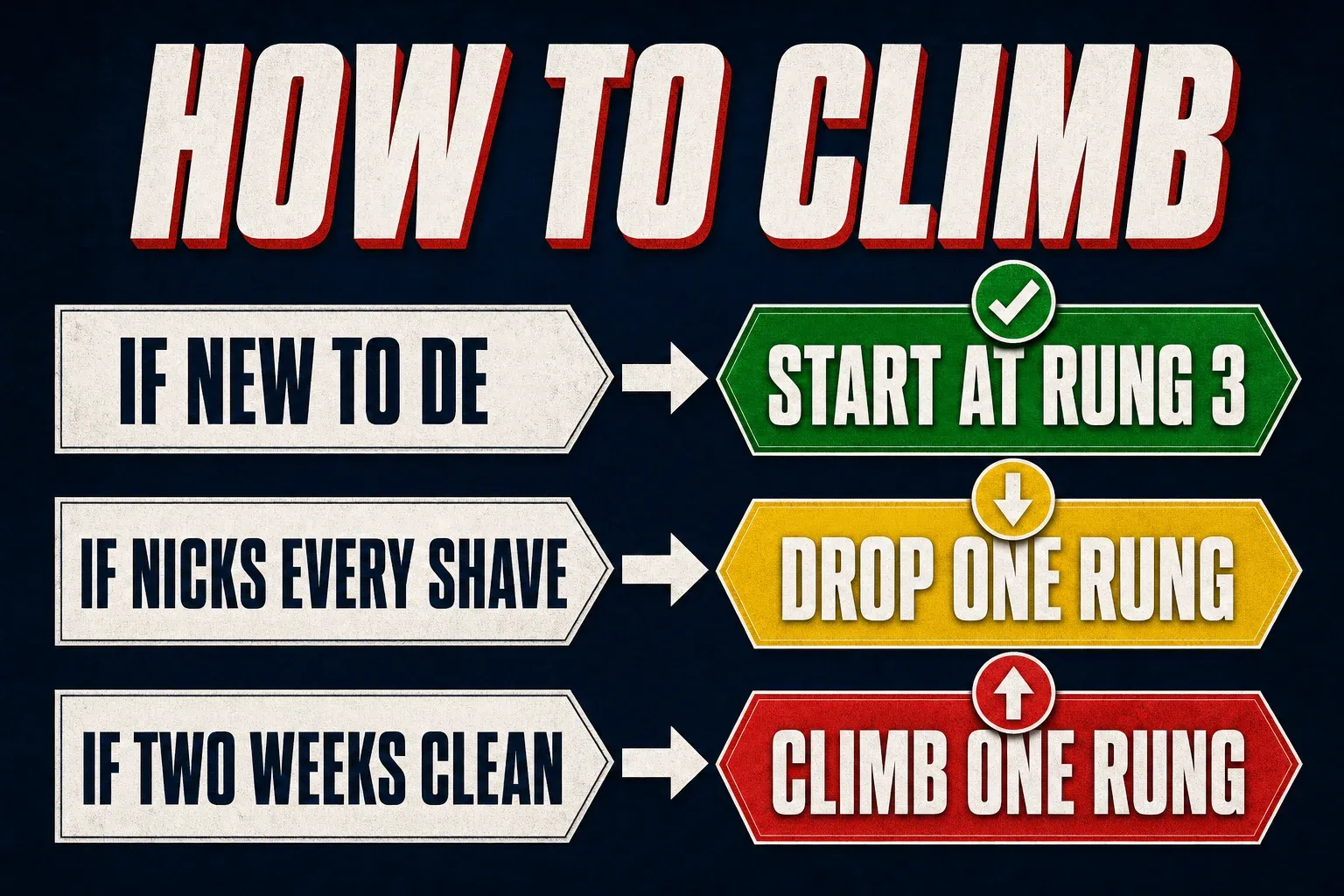
If you are new to DE and coming off cartridges, start at rung 3 with the Astra Green. Everything below is a diagnostic option, not a starting recommendation. Everything above is premature.
If you have a thick, coarse beard and are getting no closeness at rung 3, jump to rung 5 or 6 for a week. Some faces genuinely need more edge to get through the growth. That is not a technique problem. That is a beard-density problem.
If you have reactive skin or you are picking up nicks on every shave, drop a rung, not two. Small moves are how you learn what your face wants. Big moves obscure the signal.
Do not climb until you are getting consistent, irritation-free shaves at your current rung for two weeks straight. The ladder is a progression. Climbing before your technique catches up just means you are having a bad time on a sharper blade than the one that was already causing you a bad time.
The ladder is not linear per shaver. Some faces stall happily at rung 3 or 4 for years and never climb. That is a valid landing spot. The Astra Green is the daily driver of shavers who could handle a Feather but do not need to.
What to Actually Buy First
The honest first purchase for a new DE shaver is a sampler pack of five or ten different blades in singles, so you can feel the difference between rung 3 and rung 8 on your own face without committing to a hundred-blade box of the wrong answer. Sampler variety packs are widely available and typically cost less than a single tin of most artisan soaps.
Once you know your rung, buy the hundred-pack of your blade. A hundred blades at three shaves each is a year of shaving for a daily shaver. At two years, blades are the single cheapest ongoing expense in a wet-shaving kit.
The Bottom Line
Feather is not better than Astra. Astra is not better than Feather. They are different rungs on the same ladder, and every face lives at a different rung. The ladder is how you find yours, and once you have found it, you can stop worrying about which blade is best and start enjoying the shave you already know how to give yourself.
Frequently asked questions
What is the sharpest double-edge blade?
Feather Hi-Stainless is the reference for the sharpest blade in wide use. Nothing readily available is sharper, but sharpest is not the same as best: it is also among the least forgiving.
Is a sharper blade better?
Not necessarily. Sharpness is cutting force and smoothness is what the edge feels like crossing skin, and they are different properties. A blade that feels harsh is often rough rather than simply keen.
Which blade should a beginner start with?
Astra Superior Platinum is the usual default: mild enough to be forgiving, sharp enough to work, and cheap. It sits low on the ladder deliberately, so you can climb from there as technique settles.
How do I find the right blade for me?
Buy a variety sampler of singles rather than committing to a hundred-pack. Blade response is personal, and feeling the difference between a mild and a sharp blade on your own face is faster than reading about it.
How often should I move up the ladder?
Only after two straight weeks of consistent, irritation-free shaves at your current rung, and one rung at a time. Small moves are how you learn what your face wants; big jumps obscure the signal.
Happy shaving.