

Why Face Lathering Burns and What to Do About It
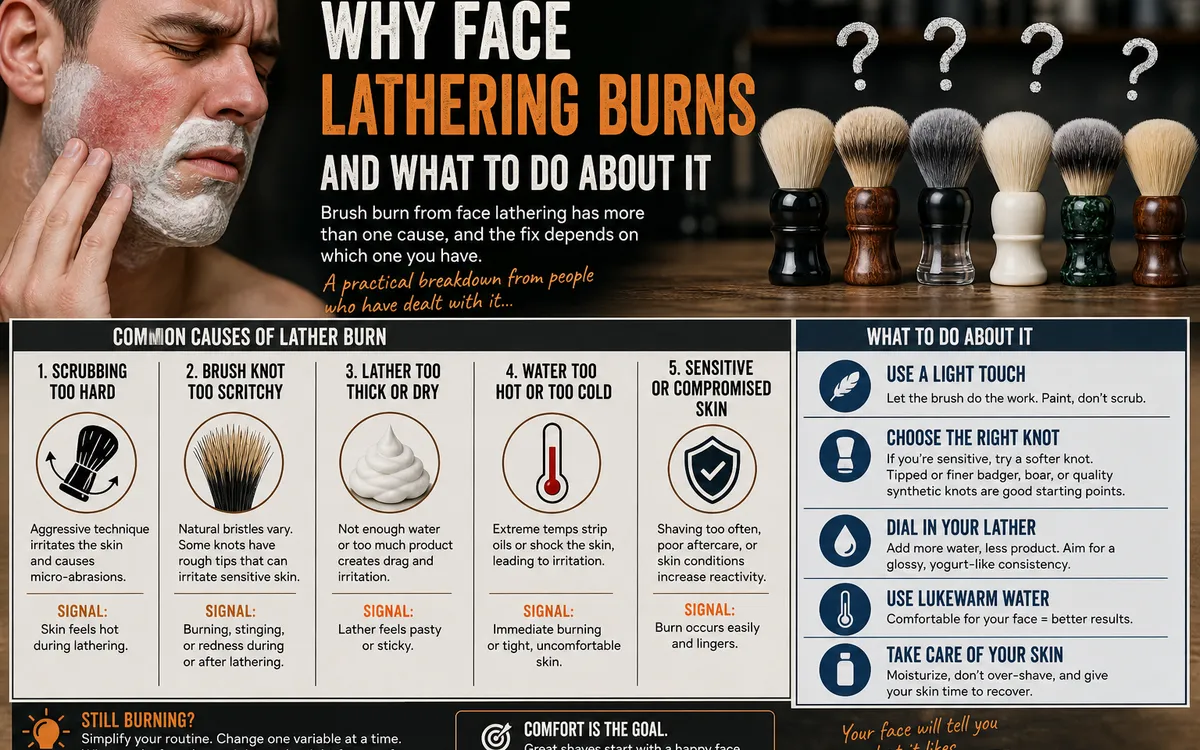
Face lathering is supposed to feel good. Warm brush, light pressure, building the lather right against your skin. But if you’re walking away from the sink red and raw after every session, something is wrong.
The question is which thing. Brush burn has more than one cause, and the fix depends on which version you have. Change the wrong variable and you’re still irritated, just with a new bowl.
Start With the Fragrance Test
This is the diagnostic step most people skip.
Grab an unscented soap and use it for a week. If the irritation clears up, you’ve got fragrance sensitivity, not mechanical brush burn. Those are different problems. Fragrance sensitivity means finding soaps your skin tolerates. Changing your technique won’t help that.
If the burn persists with an unscented soap, the brush-on-skin contact is the actual issue. Now you’re looking in the right place.
Frequency Is a Factor Too
This one is easy to overlook.
Andy is describing something real. Skin doesn’t fully recover from a close shave in 24 hours, especially with a fresh blade. If you shaved late last night and again early this morning, or if you’ve been going daily with a new Feather, the surface is compromised. The brush isn’t doing anything unusual. The skin just isn’t ready for it.
Pay attention to whether the irritation shows up more after back-to-back shaves or right after swapping in a fresh blade. If there’s a pattern there, the fix is recovery time, not a new brush.
Technique: Paint Strokes Instead of Circular
Most people who start face lathering default to circular scrubbing. It feels like you’re working the soap in. The problem is circular strokes splay the brush fibers hard against the skin, and if you’re doing that across your whole face for the entire lathering phase, you’re running fibers across the same patches again and again.
Beau put it simply:
Paint strokes means short strokes in one direction, light pressure, carrying the lather to the face rather than generating it against the face. You’re distributing, not building. The brush glides instead of drags. Loz seconded this. It’s a small change that makes a real difference if you’ve been leaning on the brush harder than you need to.
Darcy’s instinct was right too: being mindful of not splaying the brush on the face is most of the fix, once you’re conscious of it.
The Knot Might Be the Problem
Different fibers behave very differently against skin.
Eric finds badger rough but boar tolerable. Chris moved to synthetics entirely and doesn’t miss badger. Darcy tried synthetics and found them noticeably gentler. Damon got relief by switching to a 70/30 badger/boar blend from Maggard’s, though he notes it takes some break-in time before it fully softens up. He also mentions it lathers like a pillow once it’s there.
Synthetics are the consistent bet for sensitive skin. Soft from day one, no break-in needed, and the better ones load and release lather without requiring heavy pressure. If you switch from a stiff badger to a soft synthetic and the irritation stops, that’s your answer and you don’t need to look further.
A few synthetics that are easy to pick up: the Supply Silvertip is a soft-tipped synthetic that loads fast and feels gentle against the face. The TWSS Black G5 and TWSS White G5 are house brushes built around a dense G5 fiber knot, full without being scrubby. If you want a low-commitment way to try a synthetic before stepping up, the Gillette synthetic brush is the entry-level pick.
Bowl Lathering as a Fallback
Bowl lathering doesn’t fix a fragrance problem or a frequency problem. But if the issue is friction during the building phase, moving to a bowl takes your face out of that phase almost entirely. You work the brush hard in the bowl, build the lather there, then paint it onto your face with light strokes. The skin gets finished product, not friction.
Donald switched to bowl lathering exclusively and hasn’t looked back.
On bowl recommendations: the Captain’s Choice copper bowl came up twice independently, from Ron and from Brett. Two separate unprompted votes in the same thread is about as close to a consensus as you get. It’s built for this, with the weight and depth that actually make lather building easier. Damon recommends the Van Yulay honeycomb bowl, which uses a textured interior to grip the brush and, in his experience, whips up a lather fast. Both are solid options.
If you want to tub-load first and then build in the bowl before touching your face, that works well. Load from the tub, build in the bowl, paint onto the face. You keep the soap you already own and just remove the friction step from the face entirely. That was Darcy’s plan and it’s a sensible one.
Work Through the Causes in Order
If face lathering is tearing up your skin, run through the causes before you spend money. The fragrance test costs nothing. Adjusting your shaving frequency costs nothing. Changing your stroke from circular to directional costs nothing. Knot type and bowl hardware come later, if you still need them after the first three.
Most people find the fix before they get to the bottom of that list.