

Your Mach 3 Is Costing You $300 a Year. Here Is the Math.
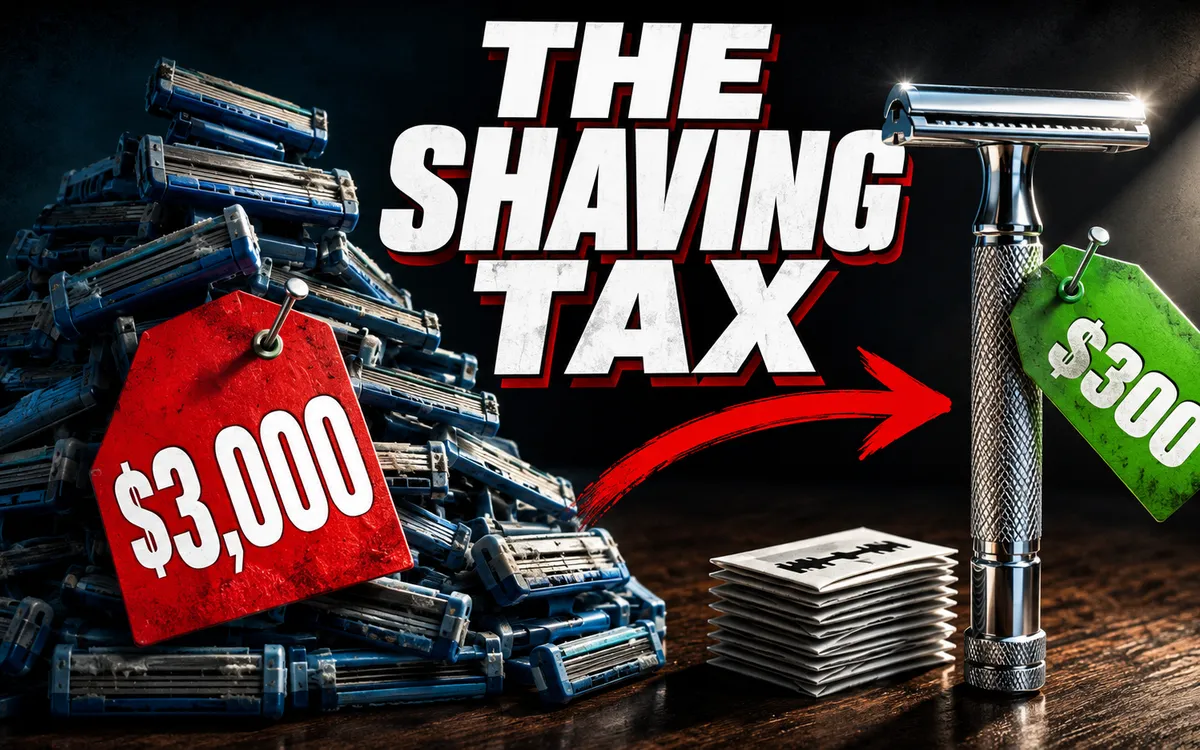
The Mach 3 sitting in your medicine cabinet is a subscription in disguise. If you shave five days a week and replace the cartridge when it starts to pull (which is what most guys actually do, not the seven shaves Gillette prints on the box), you are spending somewhere between $250 and $350 a year on razor cartridges alone. Over ten years that is a car payment. Over a working life it is a nice used sedan.
A double-edge safety razor pays for itself in about four months and then costs a rounding error to run after that. This is not a hobbyist opinion. It is arithmetic. Here is the arithmetic, and here is what to buy instead.
The Cartridge Math
The average American man shaves five days a week. Call it 260 shaves a year, allow for the days you skip and the days you shave twice for a night out, and 260 is the right ballpark for a working guy who shaves before the office.
Gillette’s own consumer guidance says to replace a Mach 3 cartridge after five to seven shaves. In practice, most shavers change earlier, at three to five, once tugging and burn start setting in. Take the middle of that real-world range: four shaves per cartridge. Two hundred and sixty shaves a year divided by four is sixty-five cartridges a year.
Standard four-pack of Mach 3 at Amazon or a drugstore lands between $16 and $22, which puts each cartridge at $4 to $5.50. Sixty-five cartridges at $4 is $260 a year. Sixty-five at $5.50 is $358. A daily shaver on Mach 3 Sensitive or Turbo pricing lands well over $400.
Ten-year total: $2,600 to $3,000 for the average shaver, more for the daily shaver, considerably more if you ever upgraded to a Fusion or a Labs.
That is the shaving tax. Nobody itemizes it because it drips out $22 at a time. Itemized, it looks like this.
- Mach 3 Cart 5-Packx12$239.88
- Mach 3 Turbo 5-Packx1$22.99
- Shave Gel 7ozx2$9.98
Why This Happens
King C. Gillette did not invent the safety razor. He invented the business model. The idea was to sell the razor almost at cost, then sell replacement blades forever. His original patents on the double-edge blade expired in 1921 and the market flooded with competitors making compatible blades that fit any DE razor from any manufacturer. Prices collapsed. A decade of price competition later, a shaver could buy a lifetime of blades for the cost of a single week’s cigarettes.
Gillette’s response, over the following decades, was the cartridge razor. Cartridges are proprietary. Each generation was engineered so that only the current cartridge fits the current handle, and each new generation added another blade or another vibration motor or another lubricating strip that the previous handle could not accept. That is not innovation. That is a compatibility lock. The steel that touches your face has not meaningfully changed since the 1970s.
Wilkinson Sword, Bic, Harry’s, Dollar Shave Club: same model, different logos. Every one of them is selling you a cartridge that costs a few cents to manufacture at a price ten to twenty times that. The subscription-box companies just cut the retailer out and pass a fraction of the savings back to you. You are still paying the shaving tax.
The DE Math
A double-edge razor uses a single flat steel blade that any manufacturer can make. The market for DE blades never got locked down the way cartridges did. There are dozens of brands, most of them made in the same handful of factories in Russia, Turkey, Germany, and Japan, and every one of them fits every DE razor ever made.
Year one, with a full starter kit purchased new:
- Razor: a Merkur 34C or Edwin Jagger DE89 runs $40 to $50 and lasts a lifetime. Not “a lifetime” as marketing, actually a lifetime. The three-piece Merkur design has not changed since the 1960s and there are working examples on eBay from the 1950s that still shave.
- Blades: a hundred DE blades runs $10 to $20 depending on brand. That is more than a year of shaving.
- Soap: a puck of Proraso Green or Stirling Bay Rum runs $8 to $15 and lasts three to six months of daily use.
- Brush: a boar brush like the Omega Pro 48 is under $20, breaks in beautifully, and lasts decades. If you want zero break-in, the Omega Hi-Brush synthetic is a similar price.
- Aftershave: a bottle of Aqua Velva Ice Blue or Old Spice classic is $6 to $10 and lasts a season.
Year one total: about $85 to $115 for a starter kit that beats a $300 cartridge year on shave quality.
Year two and beyond: blades ($10 to $20 a year, generous), soap replacement ($15 to $30 a year), splash refill ($8 to $15). Call it $35 to $65 a year, forever.
Ten-year total for the DE shaver: about $500 to $700 including the year-one gear. The cartridge shaver spent $2,600 to $3,000 to get a worse shave over the same decade.
Itemized, year one looks like this.
- Merkur 34C HD Razorx1$48.00
- Astra SP 100-Blade Packx1$12.00
- Proraso Green Creamx1$9.00
- Omega Pro 48 Boar Brushx1$18.00
- Aqua Velva Ice Bluex1$6.00
The Break-Even
Take a shaver switching to DE tomorrow. The starter kit costs about a hundred dollars, which is what a cartridge shaver spends on Mach 3 in twenty weeks at $5 a week. Twenty weeks in, about four months, the DE has paid for itself. From there, every week is money you keep. The cartridge shaver next to you keeps paying $5 every week until they stop. Your incremental cost drops to pennies a shave.
What to Actually Buy
The starter kit lives at three price tiers.
Entry, under $80 total. A Merkur 34C HD razor, a hundred-blade pack of Astra Superior Platinum, a puck of Proraso Green, an Omega Pro 48 boar brush, a bottle of Aqua Velva. This is the classic Italian barbershop kit. It lasts a year, gives you a better shave than the cartridge, and costs less than three months of Mach 3.
Mid, under $150 total. An Edwin Jagger DE89 razor, a variety of blade brands (Gillette Silver Blue, Gillette Nacet, Voskhod), a tin of Stirling Bay Rum soap, the Omega Hi-Brush synthetic, and an Old Spice classic splash. Better handle, wider blade sampling, artisan soap.
Upgrade path. Once you know your face, add a sharper blade like Feather Hi-Stainless for the days you want a really close shave and a milder blade like Personna Lab Blue or Derby Extra for the days you don’t. Add a Rockwell 6C if you want a razor with adjustable aggressiveness plates so you can dial in the shave per pass.
Total lifetime spend, even on the upgrade tier: less than three years of Mach 3 use.
The Objections
“But DE razors are dangerous.” A single sharp blade at a fixed angle is less dangerous than a five-blade cartridge that drags across the skin under pressure. The first three shaves with a DE will teach you not to press. After that, the DE cuts less skin than a Mach 3 ever did. And if you do nick yourself, the cost is a ten-cent blade, not a five-dollar cartridge.
“But DE takes longer.” Thirty seconds longer per shave, by honest measure. Thirty seconds a day, five days a week, fifty-two weeks. That is about two hours a year of extra time to save $250. If you can find a side gig that pays $125 an hour, take it. Otherwise, the DE math is a raise.
“But my skin is sensitive.” Sensitive skin is exactly where the DE wins. Multi-blade cartridges lift each hair before cutting it, so the hair ends up cut below the skin surface. That is the hysteresis effect, and it is the primary cause of razor bumps, ingrowns, and post-shave burn. A single sharp blade at the surface is what sensitive skin has been asking for the whole time.
The Bottom Line
The Mach 3 is a good enough shave engineered around a business model that keeps you paying five dollars a week for the rest of your life. The DE is a better shave engineered around a business model that ended in 1921. Whichever you pick, the cost gap is not a matter of opinion. It is subtraction.
Two hundred and fifty dollars a year, every year, until you stop shaving. That is what the switch is worth.
Frequently asked questions
Is double-edge shaving actually cheaper than cartridges?
Substantially. Cartridges are the expensive part of a cartridge system, while double-edge blades cost pennies each, so the ongoing cost drops to a small fraction of what a cartridge shaver spends.
How long until a double-edge kit pays for itself?
A starter kit costing about a hundred dollars is roughly twenty weeks of Mach 3 spending at five dollars a week, so about four months. After that every week is money kept.
Why are cartridge refills so expensive?
The razor handle is sold cheaply and the recurring cartridge is where the money is made. That is the whole business model, and it is why the running cost never comes down.
Does a cheaper blade mean a worse shave?
No. Double-edge blade price has very little to do with quality, and some of the most respected blades are among the cheapest. What matters is which blade suits your face, not what it cost.
What does a starter double-edge kit include?
A mild razor, a blade sampler rather than one brand, a brush, a soap or cream and something soothing afterwards. Most of it lasts for years, which is what makes the running cost so low.
Happy shaving.