

Signs It's Time to Upgrade Your Safety Razor (and When It's Really Your Technique)
There is a particular itch that shows up a few months into DE shaving. The novelty of your first razor has worn off, you have watched enough shave videos to know that machined stainless razors and adjustables exist, and you start to wonder whether the reason your shave is not perfect is the tool in your hand. So you go looking for permission to buy a new razor.
Most of the time, you do not need one. The uncomfortable truth is that the overwhelming majority of “I think I need a better razor” problems are technique problems wearing a costume, and a new razor just moves the same problem to a shinier handle. But not always. Sometimes you genuinely have outgrown your razor, and when that happens there are clear signs, and each sign points to a specific kind of upgrade rather than just “something more expensive.” This post is about telling the difference, and then buying the right thing if you land on the buy side.
First, Rule Out the Thing That Is Usually the Real Problem
Before you spend a dollar, run the honest checklist, because a new razor cannot fix any of these.
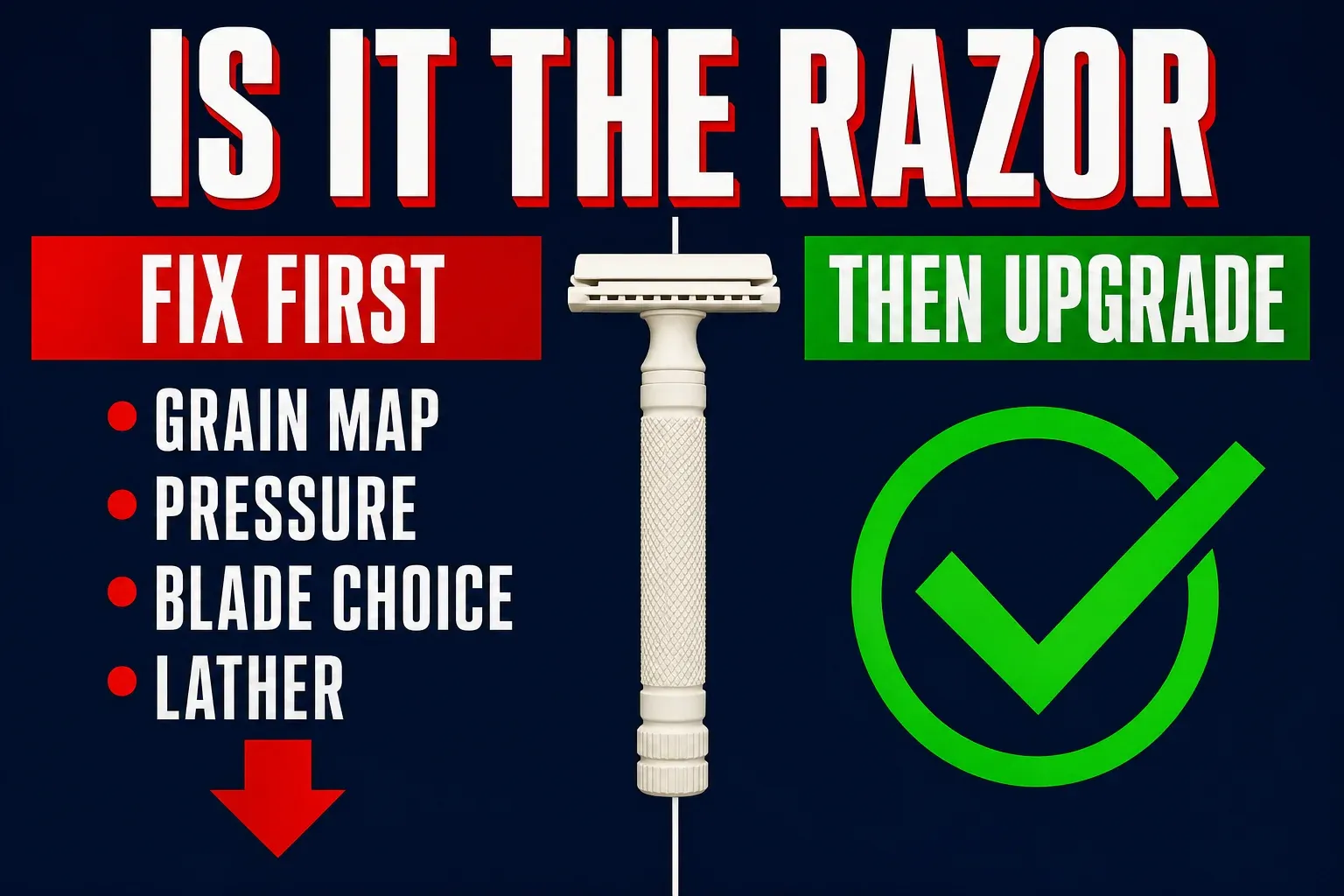
Have you mapped your grain? Most irritation and most “it will not get close” complaints come from shaving across or against the grain without knowing it, especially on the neck. Are you using pressure? A safety razor is meant to ride with almost no downward force, and pressure is the single most common cause of burn and weepers. Have you found a blade your face actually likes, tested from an inexpensive sampler rather than assumed? Is your lather wet and slick enough to let the blade glide, or is it dry and dragging? And are you doing more than one pass, re-lathering between each, reducing the beard in stages rather than trying to win in one aggressive scrape?
If any of those is a no, fix it first. A more efficient razor in untrained hands does not give you a better shave, it gives you the same mistakes at higher speed, with more blood. Two weeks of clean technique on the razor you already own will out-perform any upgrade you could buy this week. Only once you are getting consistent, comfortable shaves and still feel a specific limitation is it time to look at the razor itself.
Sign One: Your Technique Is Solid and You Still Need Three Passes
This is the clearest legitimate signal. Your grain map is dialed, your pressure is light, your lather is good, and you still cannot get a comfortable close shave in two passes. Some faces, particularly coarse or dense beards, simply need more efficiency than a gentle starter razor delivers. This is not a technique failure. It is the razor being the limiting factor at last.
The fix is a more efficient head, and efficient is the word to hold onto rather than aggressive. Efficiency means the razor removes more beard per pass with less coaxing; aggression is just a blunt way of getting there that punishes mistakes. The Blackland Blackbird is the modern reference for an efficient razor that is still forgiving, a stainless workhorse widely credited with clearing a heavy beard in two passes, and it has become the default recommendation for exactly this graduation. The RazoRock Game Changer is the value pick in the same lane, an efficient head at a fraction of the stainless-artisan price. And a plate-based razor like the Karve Christopher Bradley lets you buy one handle and dial the efficiency by swapping plates, so you never guess wrong twice.
Sign Two: Your Beard Got Ahead of a Mild Razor
Beards change. Growth that a mild Merkur 34C or Edwin Jagger DE89 handled comfortably at the start can coarsen over the years until those same razors leave you tugging and doing a third and fourth pass to finish. When the razor that used to be enough is now working too hard, you have outgrown it, and forcing more passes through a mild razor causes more irritation than moving up a notch ever would.
Two directions solve this. A slant like the Merkur 37C shears through coarse growth at an angle, which lets a moderately mild razor cut tough hair with less effort, and it is one of the cheapest ways to add real capability. Or step to a genuinely efficient head, the Blackland Blackbird again or the RazoRock Game Changer, and let the razor do the work your old one could not.
Sign Three: You Want One Razor That Adapts Instead of Five That Do Not
If you find yourself owning a mild razor for sensitive days, thinking about an efficient one for heavy stubble, and wishing you could split the difference for a quick touch-up, you do not want three razors. You want an adjustable. An adjustable razor changes its blade gap with a dial, so a single tool covers a timid setting for a rushed morning and a serious one for a full three-pass Sunday shave.
The Merkur Progress is the classic, affordable entry to adjustables and a razor plenty of shavers never feel the need to move beyond. The Merkur Futur is the bolder, heftier take for those who like a substantial razor. The Parker Variant brings the adjustable mechanism into a more modern, coated form. And at the top of the category, the Rex Ambassador is the machined stainless adjustable that many shavers describe as the last razor they will ever need to buy. If you would rather adjust by swapping solid plates than turning a dial, the Rockwell 6C does the same job with six efficiency settings and no moving parts to wear.
Sign Four: The Razor Feels Cheap in Your Hand
Some starter razors are cast from zinc alloy under a chrome plating, and while plenty of them shave perfectly well, a few feel light, hollow, or a little chattery on the face, and the plating can wear or chip over years of use. If your razor feels like a disposable object rather than a tool, and that bothers you, that is a legitimate reason to move to a machined all-metal razor built to outlast you.
This is where solid stainless steel and titanium earn their price. The Rockwell 6S is the accessible way in, the stainless sibling of the plate system many shavers already trust. The Timeless Titanium and its stainless relatives are precision-machined, dense, and effectively permanent. The Rex Envoy and Rex Konsul bring machined-stainless quality with a fixed, refined shave for those who do not want an adjustable. A razor like this is a genuine buy-it-for-life object, and if the flimsy feel of your current razor is the thing nagging at you, it is the honest fix.
Sign Five: You Are Blaming Blades for a Razor Problem
Watch for this pattern. You have bought four kinds of blades, none of them fixed the comfort or closeness issue, and you are about to buy a fifth. Blade choice matters, but past a point, endless blade swapping is a sign the limitation is the razor’s geometry, not the steel. A razor with a blade gap poorly matched to your beard cannot be blade-tuned into the right razor for you.
The cure is a razor that either has a better-matched fixed geometry or lets you tune it directly. An efficient fixed razor like the Blackland Blackbird ends a lot of blade-chasing outright, because it simply cuts, and once it does you stop hunting for a blade to compensate. An adjustable like the Merkur Progress or a plate razor like the Karve Christopher Bradley lets you change the gap itself, which is the variable you were actually trying to fix by swapping blades. Solve it at the razor and the blade question gets quiet.
Sign Six: The Shave Became the Point
Not every upgrade is about performance, and that is fine as long as you are honest that it is not. For a lot of us the daily shave stopped being a chore and became the calm ten minutes we look forward to, and at that stage a beautifully made razor is a small, durable pleasure rather than a performance necessity. There is nothing wrong with buying a machined stainless razor because you enjoy the craft of the thing in your hand, provided you are not telling yourself it will fix a shave that was never broken.
If this is you, the Rex Ambassador, the Timeless Titanium, and the Blackland Blackbird all sit at the intersection of genuinely excellent shaves and objects worth owning. And if you have thoroughly explored the double-edge world and want something new to learn, a step sideways into a different system, a single-edge or an injector, scratches the hobby itch more than another DE ever will. Buy for joy, just call it joy.
What Not to Upgrade For
A short honest counter-list, because the point of this post is to save you from bad upgrades as much as to point you to good ones.
Do not upgrade to fix irritation that is really a technique problem, because the new razor will irritate you too, probably more. Do not assume a more expensive razor gives a closer shave; a well-used mild razor in trained hands beats a premium razor in untrained ones every time, and price buys durability and feel far more than it buys closeness. Do not upgrade because a video told you a razor is legendary; legendary for a coarse-bearded reviewer can mean punishing for your face. And do not buy the most aggressive razor you can find as a shortcut to closeness, because aggression without technique is just a faster way to bleed.
How to Actually Choose
| If this is your situation | Buy this kind of razor | Examples |
|---|---|---|
| Good technique, still needs three passes | More efficient | Blackland Blackbird, RazoRock Game Changer, Karve Christopher Bradley |
| Beard has coarsened past a mild razor | Slant or efficient head | Merkur 37C, Blackland Blackbird |
| Needs vary day to day | Adjustable | Merkur Progress, Rex Ambassador, Rockwell 6C |
| Razor feels cheap or hollow | Machined stainless or titanium | Rockwell 6S, Timeless Titanium, Rex Envoy |
| None of the above fit | Keep the razor you have | Spend the time on technique instead |
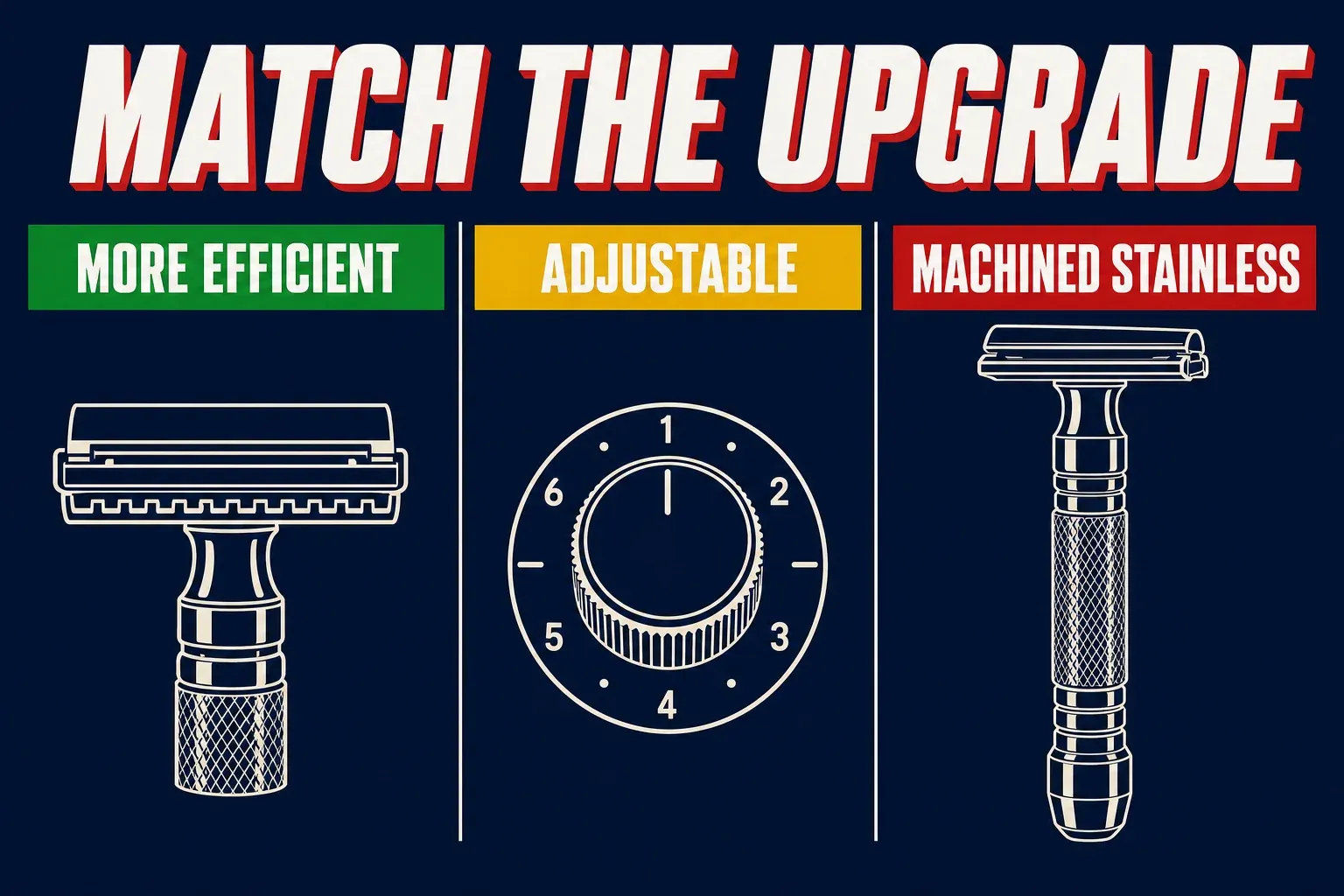
Match the sign to the fix and ignore the rest. If you have outgrown a mild razor’s efficiency, buy efficiency: the Blackland Blackbird, the RazoRock Game Changer, or a plate-tunable Karve Christopher Bradley. If your needs vary day to day, buy adjustability: the Merkur Progress to start, the Rex Ambassador to finish. If your razor simply feels cheap and you want one for life, buy machined metal: the Rockwell 6S, a Timeless, or a Rex. And if none of the signs fit, keep the razor you have, because it is almost certainly better than you are currently asking it to be, and the fastest upgrade available to you this week is another two weeks of good technique.
The Bottom Line
A new safety razor is one of the cheapest genuine upgrades in any hobby, and when you have actually outgrown yours, it is worth every dollar. But the honest version of this advice is that most of the time the razor is not the thing holding you back, and the men who get the best shaves are usually the ones who mastered a modest razor rather than the ones who kept buying new ones. Learn your face first. Then, if a real limitation remains, buy the razor that fixes that specific limitation and nothing else. That is how you upgrade like someone who knows what they are doing.
Frequently asked questions
How do I know if I need a new safety razor?
Rule out technique first. Most upgrade urges are technique problems in disguise. A genuine signal is that your grain map, pressure and lather are all dialled in and you still cannot get a comfortable close shave in two passes.
Will a better razor fix my razor burn?
Usually not. Irritation is far more often pressure, angle, a dull blade or a thin lather. A more efficient razor in untrained hands gives you the same mistakes at higher speed.
Is a more expensive razor a closer shave?
No. Price buys durability, materials and feel far more than closeness. A well-used mild razor in trained hands beats a premium razor in untrained ones.
Should I get an adjustable razor?
An adjustable makes sense if your needs vary day to day, because one razor covers a timid setting for a rushed morning and a serious one for a full three-pass shave. It replaces owning several fixed razors.
What if my razor just feels cheap?
That is a legitimate reason to upgrade. If a light, hollow-feeling razor is the thing nagging at you, a machined stainless or titanium razor is a genuine buy-it-for-life object, as long as you are honest that you are buying feel rather than fixing a shave.
Happy shaving.