

Gillette Date Codes and Serial Numbers: Date Your Razor in Seconds

Turn a vintage Gillette over and there is usually a small mark stamped into the metal. On anything built from 1950 onward it is a letter and a single digit, something like A3 or U1. On the older ones it is a long serial number with a letter attached. Either one dates the razor, often to the exact quarter, and neither takes any expertise to read once you know the trick.
The trick is the part most charts leave out, so start here.
Date your Gillette
Type the mark stamped on your razor. A letter and a digit is a date code, a longer number is a serial number, and this works out which you have.
The letter is the year, the digit is the quarter
That is the whole system. Gillette stamped a letter for the year of manufacture and a digit from 1 to 4 for the calendar quarter, so the first quarter is January to March and the fourth is October to December. A razor stamped D1 came off the line in the first three months of its D year.
Two details make the letters behave differently from how you would expect.
The first is that the alphabet has 25 letters in it, not 26. Gillette never used Q. The sequence runs A through P, jumps straight to R, and carries on to Z. This is why 1970 is P and 1971 is R, with nothing in between, and it is where published charts go wrong: at least one well ranked date code chart lists both Q and R as 1971.
The second is that the sequence repeats. Twenty five letters, twenty five years, then it starts over at A. Gillette began date coding blades in 1930 and razors only in 1950, which means razor codes start partway through the first turn of the cycle, at V. A chart that opens with A meaning 1950 is off by five years on every row it prints.
| Letter | 1930 to 1954 | 1955 to 1979 | 1980 to 2004 |
|---|---|---|---|
| A | 1930 | 1955 | 1980 |
| B | 1931 | 1956 | 1981 |
| C | 1932 | 1957 | 1982 |
| D | 1933 | 1958 | 1983 |
| E | 1934 | 1959 | 1984 |
| F | 1935 | 1960 | 1985 |
| G | 1936 | 1961 | 1986 |
| H | 1937 | 1962 | 1987 |
| I | 1938 | 1963 | 1988 |
| J | 1939 | 1964 | 1989 |
| K | 1940 | 1965 | 1990 |
| L | 1941 | 1966 | 1991 |
| M | 1942 | 1967 | 1992 |
| N | 1943 | 1968 | 1993 |
| O | 1944 | 1969 | 1994 |
| P | 1945 | 1970 | 1995 |
| R | 1946 | 1971 | 1996 |
| S | 1947 | 1972 | 1997 |
| T | 1948 | 1973 | 1998 |
| U | 1949 | 1974 | 1999 |
| V | 1950 | 1975 | 2000 |
| W | 1951 | 1976 | 2001 |
| X | 1952 | 1977 | 2002 |
| Y | 1953 | 1978 | 2003 |
| Z | 1954 | 1979 | 2004 |
Why your code can have more than one answer
Because the cycle repeats, a bare letter is not unique. D is 1933, 1958 and 1983 all at once.
For almost every razor you will ever hold, that ambiguity disappears on its own. US razors were date coded from 1950, and the run of production that matters lands inside a single turn of the cycle, so the letters A through U mean exactly one year each: 1955 through 1974. If your razor is stamped anything from A to U, there is one answer and the chart gives it to you.
The exceptions are V, W, X, Y and Z. Those five sit at the tail of one cycle and the head of the next, so each of them genuinely means two possible years: 1950 through 1954, or 1975 through 1979. A V4 is the fourth quarter of 1950 or of 1975, and no amount of squinting at the stamp will separate them. The later dates are much the rarer of the two, since US double edge production was winding down by then, but they are real.
What separates them is the razor itself. Collectors settle it on the hardware: a heavy three piece or a ball end Super Speed points to the earlier pair of dates, while a plastic handled razor or a Black Beauty points to the later one. The hardware narrows what the stamp cannot.
Where the mark actually is
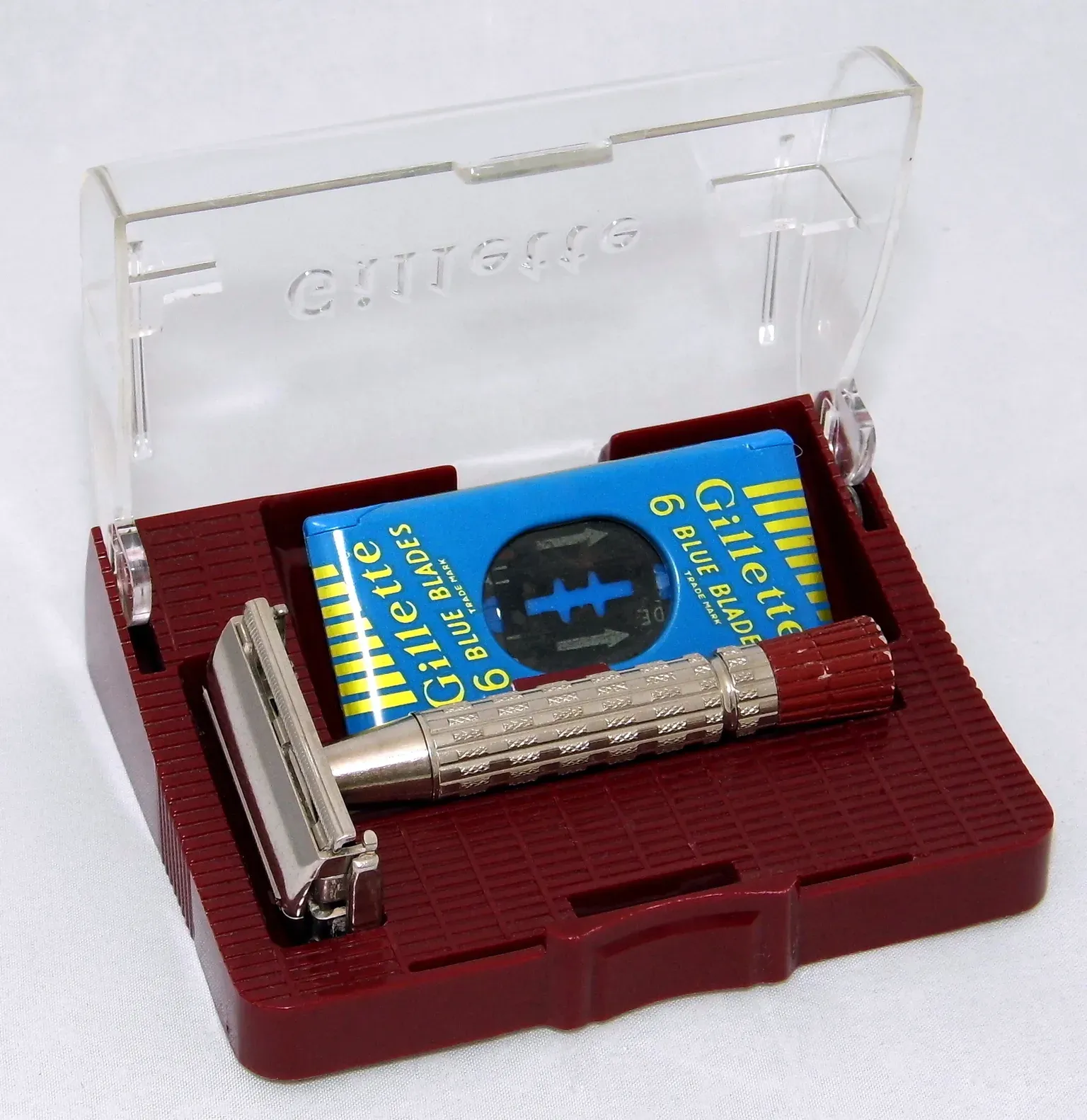
On three piece and one piece razors the date code sits on the underside of the guard, tucked into the corners, so you have to turn the razor over and catch it in good light. On a three piece you can simply unscrew the handle and look at the baseplate directly, which is much easier than trying to read it assembled.
Worn plating and eighty years of soap scum make these stamps hard to read, and two misreadings are extremely common. A tired O reads as a Q, which cannot be right because Q was never used. And a blurred 0 or 1 reads as an O or an I, neither of which Gillette used in serial numbers for exactly that reason, though both do appear in the date code alphabet.
Before 1950, look for a serial number
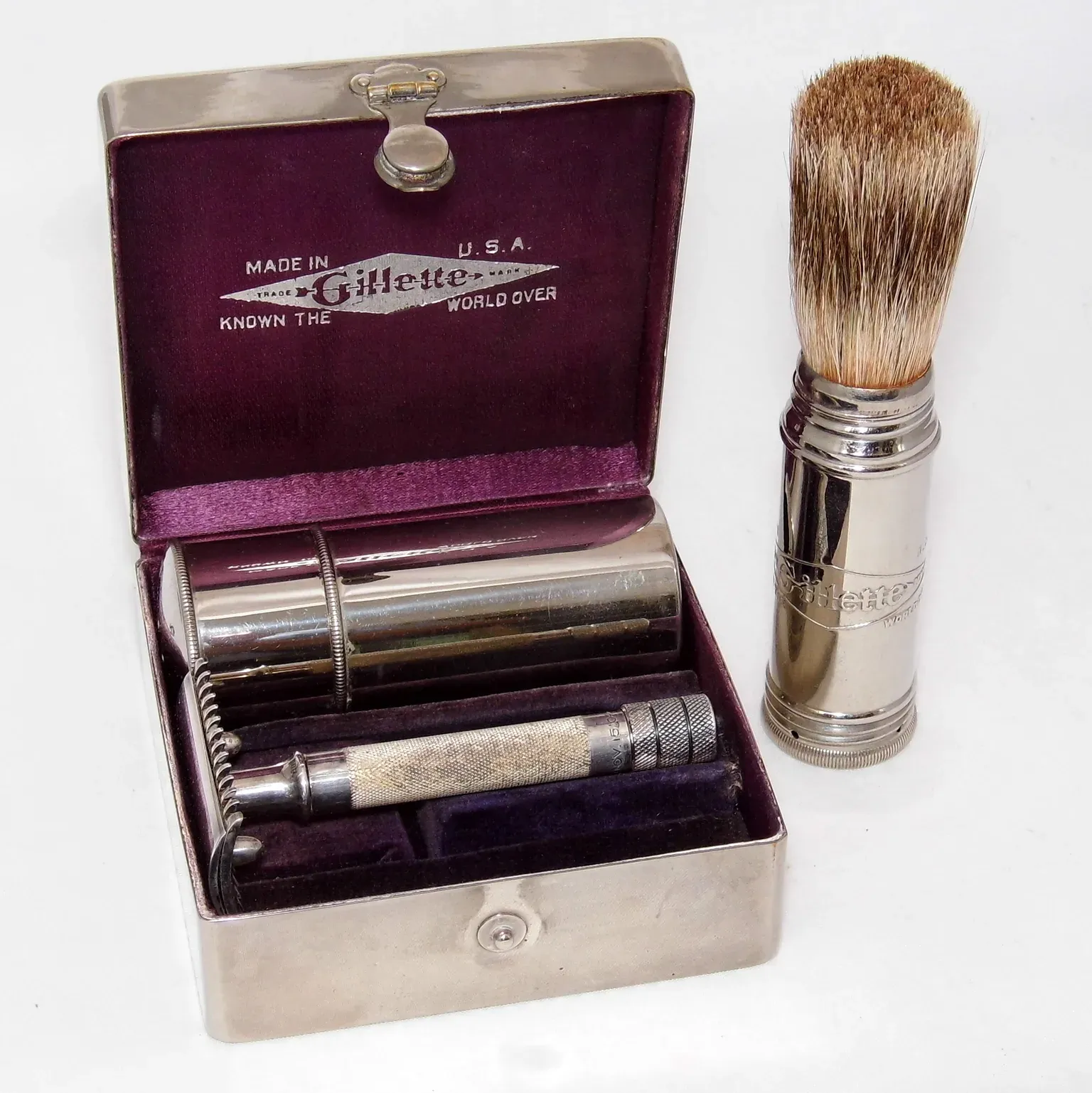
Razors built before the date code system carry a serial number instead, and those run much further back. Gillette stamped them on every razor from late 1904 until 1921, and on the deluxe models for another decade after that. They sit on top of the guard, or sometimes inside the barrel of the handle.
Serial numbers ran as one long sequence rather than resetting each year, so the number gives you a year rather than a quarter. The position of the letter tells you which family you are holding: an Old Type prints the letter in front of the number, and a New Improved prints it afterwards.
| Year | Old Type, letter first | New Improved, letter last |
|---|---|---|
| 1903 | None issued | |
| 1904 | 1 to 45,424 | |
| 1905 | 45,425 to 370,424 | |
| 1906 | 370,425 to 770,424 | |
| 1907 | 770,425 to 999,999, then A1 to A195,424 | |
| 1908 | A195,425 to A675,857 | |
| 1909 | A675,858 to A999,999, then B1 to B222,220 | |
| 1910 | B222,221 to B697,600 | |
| 1911 | B697,601 to B999,999, then C1 to C80,508 | |
| 1912 | C80,509 to C260,238 | |
| 1913 | C260,239 to C407,806 | |
| 1914 | C407,807 to C578,360 | |
| 1915 | C578,361 to C911,086 | |
| 1916 | C911,087 to C999,999, then D1 to D516,474 | |
| 1917 | D516,475 to D999,999, then E1 to E449,207 | |
| 1918 | E449,208 to E999,999, through F and G and H, then J1 to J7,344 | |
| 1919 | J7,345 to J999,999, then K1 to K927,216 | |
| 1920 | K927,217 to K999,999, through M, then N1 to N459,887 | |
| 1921 | N459,888 to N999,999, then P1 to P679,777 | 1-A to 863,912-A |
| 1922 | 863,913-A to 999,999-A, then 1-B to 336,676-B | |
| 1923 | 336,677-B to 391,575-B | |
| 1924 | 391,576-B to 485,927-B | |
| 1925 | 485,928-B to 602,049-B | |
| 1926 | 602,050-B to 770,070-B | |
| 1927 | 770,071-B to 902,611-B | |
| 1928 | 1-C to 94,800-C | |
| 1929 | 94,801-C to 241,755-C | |
| 1930 | No US production |
What if there is no date code at all
This is the most common dead end, and it has a real answer.
Turn the razor over and you find patent language where you expected a code. Something like PAT. NOS. ON PACKAGE, or the abbreviated PAT. NOS. ON PKG., usually alongside REG. U.S. PAT. OFF. and MADE IN U.S.A. None of that is a date. REG. U.S. PAT. OFF. is a trademark notice and says nothing about when the razor was built, and the patent line is pointing you at a paper insert that was thrown away decades ago.
What you are almost certainly holding is a razor from the gap. Serial numbers stopped in the 1920s and date codes did not start until 1950, so a Tech or a Super Speed from the 1930s or 1940s carries neither mark. It is not missing anything. It was never stamped.
The patent line still narrows it, though, because the wording changed. Gillette spelled PACKAGE out in full on the earlier razors and switched to the abbreviated PKG around 1950, right about when date codes appeared. Collectors treat the change as a rough boundary rather than a hard date, so read it as a lean and not a verdict:
- PACKAGE spelled out, no date code: the earlier side of the line, late 1930s through about 1950.
- PKG abbreviated, with a date code next to it: 1951 onward, and the code gives you the answer anyway.
Past that it comes down to the hardware. On a three piece Tech the shape of the slots in the baseplate separates the early ones from the later ones, and the handle style, the plating and the case it came in all narrow the window further. That is the point where a field guide beats any chart, including this one.
What the mark will not tell you
A stamp is not a certificate, and there are four cases where it stops being useful.
There is a gap, covered just above. Blades were date coded from 1930 but razors were not coded until 1950, so a US razor built in the 1930s or 1940s carries neither mark.
Some razors were never numbered. Nothing before November 1904 carries a serial, and Gillette stopped numbering between October 1927 and August 1928, so a blank razor from that window is normal rather than suspicious.
A leading L, and on some razors an X, marks one that went back to the factory and was repaired. It sits outside the sequence, so it will not date the razor.
A trailing letter marks the plant instead of the year. Y is England, Z is Canada, V is Spain and W is France, and none of the US tables on this page apply to those.
Is an old razor worth shaving with
Dating one is the fun part. Shaving with it is the actual question, and the answer depends on condition far more than on the year. Check the alignment with a blade fitted, make sure the plating has not flaked anywhere it touches your face, and give any new arrival a proper deep clean before it earns a blade.
If you are weighing an old one against something machined this decade, we have a straight comparison of what each side actually gives you. And if the razor turns out to be more aggressive than you expected, that is a question of geometry rather than age, which our aggressiveness explainer covers.
Frequently asked questions
Where is the date code on a Gillette razor?
On three piece and one piece razors the date code is stamped on the underside of the guard, in the corners. On a three piece the easiest way to read it is to unscrew the handle and look at the baseplate directly. Serial numbers on older razors sit on top of the guard, or inside the barrel of the handle.
What do the letter and number on a Gillette razor mean?
The letter is the year of manufacture and the digit is the calendar quarter. Quarter 1 is January to March, 2 is April to June, 3 is July to September and 4 is October to December. So a razor stamped D1 was made in the first three months of its D year.
Why is there no Q in Gillette date codes?
Gillette skipped the letter Q entirely, so the alphabet it used is 25 letters long rather than 26. The sequence runs A through P, then jumps to R. If you think you are reading a Q, it is almost certainly a worn O or G.
Can the same Gillette date code mean two different years?
Yes. The 25 letter cycle repeats every 25 years. For US razors the letters A through U mean exactly one year each, 1955 through 1974. The letters V, W, X, Y and Z each mean two possible years, either 1950 to 1954 or 1975 to 1979, and the model of the razor is what tells you which.
How do you date a Gillette made before 1950?
Look for a serial number instead of a date code. Gillette stamped serial numbers on every razor from late 1904 until 1921, and on deluxe models for about a decade after. An Old Type prints the letter before the number and a New Improved prints it after. Razors built between 1930 and 1949 carry neither mark and are dated by model and features.
What does an L or X at the start of a Gillette serial number mean?
It marks a razor that was sent back to the factory and repaired. Those numbers sit outside the normal production sequence, so they will not date the razor.
My Gillette says PAT NOS ON PACKAGE instead of a date code. What year is it?
That is patent language, not a date, and neither is REG U.S. PAT. OFF., which is a trademark notice. A razor marked that way and carrying no date code is almost certainly from the gap between the two systems, when serial numbers had stopped and date codes had not started, so roughly the 1930s and 1940s. The wording narrows it a little: Gillette spelled PACKAGE out in full on the earlier razors and switched to the abbreviated PKG around 1950. Past that the razor is dated by model and features rather than by any stamp.
Most of these razors were built by the tens of millions and made to outlast their owners, which is why a Gillette older than most of the people shaving with one is still among the cheapest good shaves available. Knowing the quarter it was built in does not make it shave better. It does make it yours in a way a new razor takes years to manage.
Happy shaving.