

The Old Man Shave: Why Your Grandfather's Routine Beats Anything TikTok Sells You
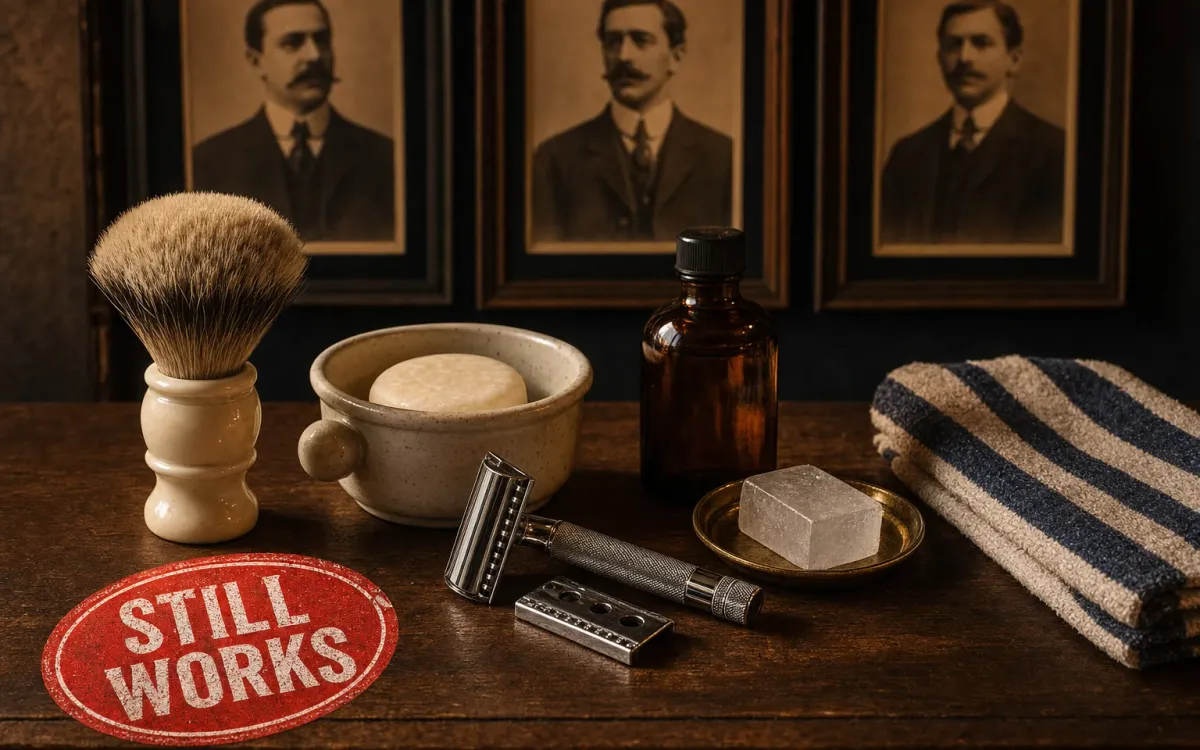
Somewhere between 1935 and 1965, a specific shave routine calcified. Hot towel on the face. Brush, mug, tallow lather. Double-edge razor, two or three passes. Cold rinse. Alum block on any weeper. Splash of something with menthol or bay rum. A pat with a dry towel. Out the door.
That routine is still on the shelf at every drugstore in America. Aqua Velva is still Aqua Velva. Old Spice classic still lives on the same drugstore shelf. Proraso is still made in Florence. Merkur is still turning out the 34C in Solingen. The double-edge blade in the safety razor your grandfather used is the same design the man in the mirror can buy at the drugstore in a hundred-pack for the price of a bag of coffee.
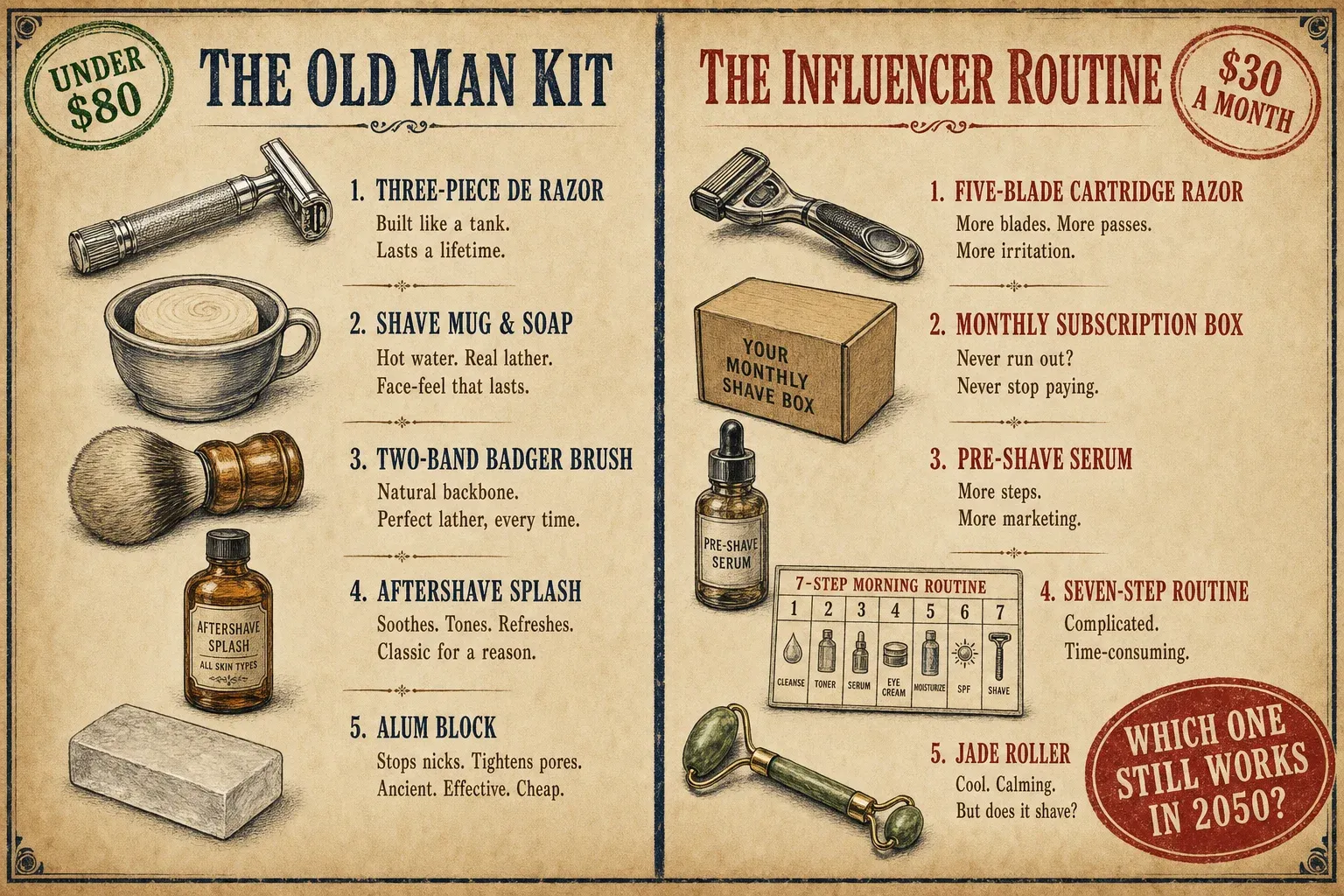
A generation of grooming-influencer content has told men on YouTube and TikTok that this routine is obsolete. That men now need a seven-step morning ritual with a hyaluronic serum, a jade roller, a $12-per-cartridge five-blade razor, and a monthly subscription box that ships a curated bundle of scented things. This is not an improvement. This is a business model.
The Routine, Six Steps
Stripped of nostalgia, the routine is six steps.
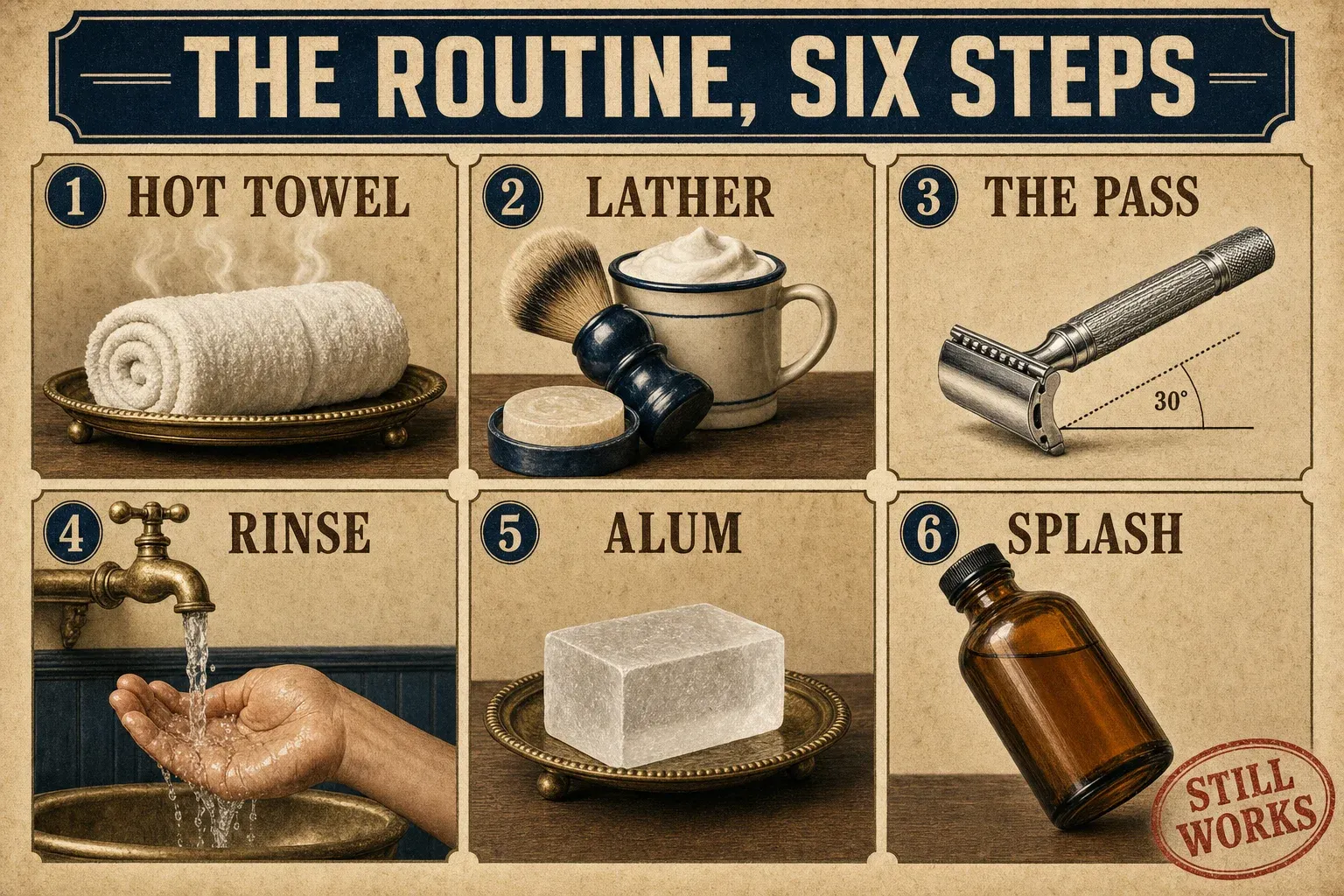
Step 1: Hot towel. A face cloth soaked in water as hot as the hand can stand, wrung out, wrapped across the beard for a minute. This softens the hair and opens the pore, and it does exactly as much as a $40 pre-shave oil claims to do.
Step 2: Face lather. A boar or badger brush loaded off a puck of tallow soap in a mug, then worked on the face for a full minute. Not thirty seconds. A full minute. The brush is doing three things: laying down a slippery cushion, standing the hair up off the skin, and gently exfoliating the surface. This is why the modern “canned foam plus five-blade razor” combination cannot match it.
Step 3: The pass. A safety razor at roughly a thirty-degree angle, with the weight of the razor doing the work and the hand simply steering. First pass with the grain. Second pass across the grain. Third pass, if the shaver is going for baby-smooth and their face tolerates it, against the grain.
Step 4: Cold rinse. Cold water on the face. Not cool. Cold. This closes the surface and settles the skin before the splash goes on.
Step 5: Alum block. A wet alum block rubbed over the whole face. Astringent, mildly antiseptic, and the fastest way to close a weeper on the neck. Rinse the alum off after a minute.
Step 6: The splash. A splash of whatever the shaver’s grandfather kept on the counter. Aqua Velva. Old Spice. Tabac. Pinaud Clubman. Bay rum. Witch hazel neat, if the skin is picky. This is the last thing on the face, and there is no balm layered on top of it.
The full routine takes twelve minutes once the technique is dialed in. It costs about a dollar per shave in consumables at the low end, and the razor and brush pay themselves off inside a year.
Why the Products That Won Are Still on the Shelf
Every product a grandfather kept on his counter is still being manufactured, largely to the same recipe, and largely by the same companies that made it then.
Aqua Velva has been sold in the United States for close to a century, and the Ice Blue splash has been the flagship aftershave in the blue bottle for generations. Menthol tingle, cool blue scent, brisk and forgettable in the best sense of the word.
Old Spice Classic aftershave launched in the 1930s under Shulton. The scent has been tweaked over the decades under different owners, but the current Classic splash is close enough to what a grandfather would recognize that most drugstore aftershave shelves still stock it under the same name.
Tabac Original launched in 1959 in Germany under Mäurer & Wirtz. The powdery floral is either the best aftershave a man will ever wear or absolutely not for him, and no shaver’s grandfather owned it half-heartedly. The soap and splash are still made in the same factory.
Proraso launched in 1948 in Florence. The green tub of eucalyptus and menthol cream is the workhorse Italian shave cream and the fastest lather-builder on the market. Barbers in Milan use it. Barbers in Cleveland use it. The formula has changed very little over the decades.
Pinaud Clubman aftershave, made under the American Clubman brand, has been a barbershop staple for generations. Powdery, faintly floral, the smell that walks out of every neighborhood barbershop in the country.
Merkur in Solingen has been making the 34C double-edge razor to essentially the same specification since the mid-twentieth century. The 34C is still the default first-DE recommendation for beginners on every wet-shaving forum on the internet.
Omega in Brescia has been making boar-bristle brushes since 1931. The Omega Pro 48 is the same brush a barber in 1955 was using, and it is still under twenty dollars.
Feather Safety Razor Co. in Osaka has been making the sharpest common DE blade in the world since 1932. The Hi-Stainless blade in the black-and-yellow wrapper is the blade every wet shaver eventually tries.
These are the products the market did not need to replace, because the design was already correct. Continuity is the tell. When a product survives a hundred years of price competition, factory changes, and shifts in fashion, it is not surviving because the marketing is loud. It is surviving because it works.
What TikTok Added, and What It Cost
The influencer-era grooming routine adds five things a grandfather did not have and did not need.
A five-blade cartridge razor at three to five dollars per cartridge. A pre-shave oil or serum, marketed as skin preparation, doing roughly what a hot towel does for zero cents. A hydrating post-shave balm, layered on top of the splash. A separate face wash from the body soap. A morning skin routine with a serum, a moisturizer, and increasingly, a jade roller or gua sha stone.
The tally at the end of the year is somewhere between three hundred and eight hundred dollars in consumables, depending on how deep the shaver goes into the subscription-box side of the market. The grandfather’s routine, once the razor and brush are bought, runs under a hundred dollars a year in blades, soap, alum, and splash.
None of the added steps make the shave itself closer, safer, or more comfortable. What they do is turn a twelve-minute morning ritual into a forty-minute routine, and turn a self-sufficient purchase habit into a monthly subscription. This is the trade the marketing has been asking men to make. The reason it caught on is that the grandfather’s routine required a father or an uncle or a barber to teach it, and by the time most men in their thirties were shaving, that transmission had broken.
Build the Old Man Kit
The old man kit is five items. Not seven. Not twelve. Five.
Razor. The Merkur 34C, the classic starter DE, close to seventy grams of chrome-plated brass in a three-piece build. If a longer handle would help, the Merkur 23C is the same-family Classic in a longer grip.
Blades. A sampler pack to start, then a hundred-pack of the winner. The Astra Superior Platinum (Green) is the low-friction default for a face new to DE. The Feather Hi-Stainless is where a shaver eventually lands if their beard is coarse. The Voskhod sits in the middle for shavers who care more about smoothness than about maximum sharpness. Any of the three will run under thirty dollars for a hundred-pack that lasts close to a year.
Brush. The Omega Pro 48, the boar-bristle workhorse, is the same brush a barber in 1955 owned. Break-in takes two weeks. After the break-in, it is the last brush most shavers ever need. A modern synthetic like the Omega Hi-Brush is the alternative if the shaver wants the same performance without the break-in.
Soap. Proraso Green cream in a tube is the fastest way to a working lather for a new brush user. Van der Hagen’s classic drugstore puck in the round tin is the tallow-soap counterpart if a puck-in-a-mug feels right. Both are under ten dollars and both last for months.
Splash. Pinaud Clubman for the powdery barbershop scent. Aqua Velva Classic for the menthol splash. Old Spice Classic for the ceramic-bottle nostalgia. Tabac Original for the men who like the risk. Bay rum for a warmer autumn or winter splash. Any of these will run under fifteen dollars and last months.
Alum block. Not required, but the shortest path to a professional finish is a wet alum block rubbed across the face after the cold rinse and before the splash. A single block lasts years.
That is the whole kit. Five items, under a hundred dollars start to finish for the average shaver, and every consumable on the list is stocked at any decent drugstore or shipped to a doorstep in two days.
Identity, Not Product
There is a second thing the grandfather’s routine gave a man that the influencer routine cannot: it was his own. The razor was his. The brush was his. The mug on the counter was his. When he passed it down to his son, he was passing down a set of tools, not a subscription. The routine was an act of self-sufficiency, not a monthly transaction with a stranger.
This is the part the modern grooming industry cannot sell, because it costs the industry money. A man who buys a Merkur 34C and a hundred blades and an Omega brush is a man who is done spending on shave gear for the next several years. The industry does not make money on a customer who is not renewing. That is why the routine on TikTok has seven steps instead of four, and why the routine your grandfather ran is not the routine being advertised to you.
None of this is a rejection of new products. There are honestly excellent modern soaps, splashes, razors, and brushes being made by small artisan makers, and the wet-shaving world is bigger and better than it has been in fifty years. The point of the old man kit is that the baseline still works, and the baseline is where a new shaver should start.
The routine your grandfather ran was built by his father teaching him what worked, and by a hundred years of drugstore competition sanding off the things that did not. None of the modern grooming marketing has actually replaced any of it.
Buy the Merkur. Buy the Omega brush. Buy a puck of Van der Hagen and a bottle of Aqua Velva. Learn the six steps. That is the old man shave.
Frequently asked questions
What is the old man shave routine?
Six steps that settled somewhere between 1935 and 1965. A hot towel on the face, a brush and mug lather, a double-edge razor for two or three passes, a cold rinse, an alum block on any weeper, and a splash of something with menthol or bay rum. It has not needed changing since.
Does a hot towel actually do anything?
Yes. A face cloth soaked in water as hot as the hand can stand, wrung out and wrapped across the beard for a minute, softens the hair and opens the pore. It does exactly as much as a pre-shave oil costing forty dollars claims to do.
Is the modern multi-step grooming routine an improvement?
No. A seven-step morning ritual with serums, a jade roller, a five-blade cartridge at twelve dollars a head and a monthly subscription box is not an improvement on the old routine. It is a business model. None of the modern grooming marketing has actually replaced any of it.
What do I need to build an old man shave kit?
A Merkur, an Omega brush, a puck of Van der Hagen and a bottle of Aqua Velva, plus the six steps. The products that won a century of drugstore competition are still on the shelf, and a hundred-pack of double-edge blades costs about the same as a bag of coffee.
Happy shaving.