

PAA WÜRM: A Green Acrylic Brush Built From a Vintage Ghost
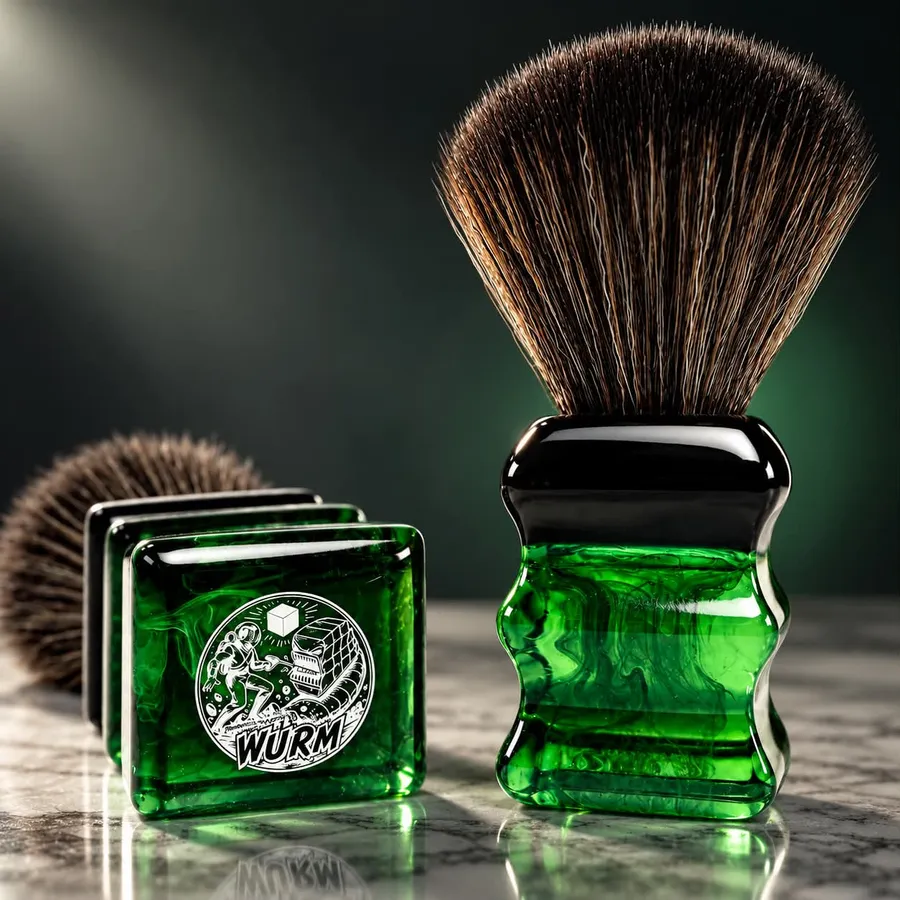
Phoenix Artisan has a habit of building brushes out of dead ends. The WÜRM is the clearest case of it yet. The handle is a green acrylic block with a deeply segmented, accordion-like body and a rectangular footprint, and it comes from a vintage brush called the Klenzo B1086 that almost nobody has seen.
That is not a figure of speech. Vintage brush collecting is a surprisingly busy corner of this hobby, with people who can date a Rubberset by its ferrule stamp, and PAA has not turned up a second documented B1086. One brush, one set of photographs, and a model number. If you own one, or you have seen one in a catalog scan, PAA would like to hear from you.
The brush nobody can find
The original was clear Lucite with a rectangular profile and that same ribbed, concertina handle. Turn it over and the base carries the usual mid-century litany: KLENZO, U.S.A., STERILIZED, SET IN RUBBER, PURE BADGER, and the B1086 model number. It also carries a circled letter M that nobody has been able to explain. A mold maker, a supplier, a factory mark, or something else entirely. PAA has not solved it and neither has anyone they have asked.
Klenzo itself is well documented even if this particular brush is not. The name belonged to the United Drug Company, the Boston operation behind Rexall and one of the big American drugstore empires of the twentieth century. Klenzo was the house brand Rexall put on its shaving goods, and collectors have catalogued a fair number of them. PAA’s research puts United Drug’s first commercial use of the Klenzo name on lather brushes at 1909, with Rexall stores advertising Klenzo shaving brushes through the 1920s, Lucite lather brushes by 1948, and genuine badger Klenzo brushes set in rubber in the early 1950s. That dates the B1086 to somewhere in the middle of the century without pinning it down.
What makes the gap odd is how well populated the rest of that numbering is. Collectors have documented Klenzo brushes running B843, B985, B1024 and B1026, in bakelite and butterscotch catalin, with knots down around sixteen to eighteen millimeters. The series is busy. The B1086 sits in the middle of it and refuses to turn up.
You can watch this happen yourself. A vintage Klenzo shaving brush comes up for sale regularly, in black, in butterscotch, restored and unrestored, often enough that the model numbers accumulate in front of you. Search the resale market for the B1086 specifically and you get nothing back at all.
There is one more thread worth pulling. The prevailing view among collectors is that Klenzo did not make its own brushes at all, and that Rexall contracted the work out to the big American brush houses of the period, with Ever Ready, Made Rite and Rubberset the names that come up most often. That is speculation rather than documented fact, and none of it explains a circled M. It is a suggestive coincidence that the Astraeus, the earlier PAA brush this knot debuted on, is an homage to a Made Rite. It is not evidence, and I am not going to pretend otherwise.
What the fine print on the bottom actually meant
The two phrases stamped on that base are the part of this story worth slowing down for, because both of them were doing real work.
“Set in rubber” was not marketing garnish. Early brushes had their knots bedded in glue, which gave up under daily soaking. Setting the fibers in rubber instead produced a bond that tolerated water far better and did not shed a knot into your lather after a year. It was a genuine manufacturing improvement, and valuable enough as a selling point that brush companies took each other to court over the right to use the phrase. Anyone who has handled a Rubberset knows how that company chose its name.
“Sterilized” points somewhere darker. In the early twentieth century, contaminated animal hair in shaving brushes was linked to outbreaks of cutaneous anthrax, badly enough that it became a public health problem rather than a curiosity. Wartime shortages and poorly disinfected hair were the usual culprits. Makers responded with boiling, pressurized steam in an autoclave, prolonged dry heat, or soaking finished brushes in formalin, and sterilization claims became standard on the product itself. By the time a brush like the B1086 was on a shelf, that word was there to settle a customer’s nerves.
PURE BADGER was doing a third job. Klenzo sold brushes in several grades, and the base told you which one you were holding. Knot material was the spec sheet in an era that did not print spec sheets.
Lucite was the future, not the past
The material is the other half of why this handle looks the way it does. Lucite was DuPont’s trade name for clear acrylic, introduced commercially in the 1930s, and the war gave it a reputation. Acrylic went into aircraft canopies, gun turrets, instrument covers, and anywhere engineers needed something transparent and light that would not shatter like glass. When it moved into civilian goods after the war it brought that association with it.
A vintage Lucite shaving brush still surfaces often, usually an Ever Ready, a Made Rite or an unbranded drugstore piece, and the material has held up better than most plastics of its age. The good ones are still clear. That is worth knowing if the shape appeals to you more than the green does.
That is the whole reason the B1086 reads the way it does. A transparent plastic handle in 1950 was not nostalgic. It belonged to aviation and laboratories and the part of the century that was going somewhere. The retro-futurism is something time added later, and it is exactly the register PAA has been working in with its Retro Shave Tech brushes for years. The Astraeus was built from a 1960s Made Rite Lucite 116 on the same logic.
What PAA changed
Reproducing the B1086 in clear acrylic would have made this a replica, and PAA did not go that way. WÜRM is green, and the color does most of the work. Light travels through the segmented body and picks up the repeating geometry, so the handle reads as layered rather than flat, and it shifts depending on how you are holding it. The vintage lineage is still obvious in the shape. The character is not vintage at all.
It is also bigger than the brush that inspired it. The segments have more room, the handle has real mass to it, and acrylic gives the whole thing a density you notice the moment you pick it up. Brushes in this shape can feel like ornaments. This one does not.
There is a coincidence in the background that PAA cannot take credit for and clearly enjoys anyway. United Drug started in Boston. Phoenix Artisan started in Massachusetts too, more than a century later. An obscure design from one Massachusetts operation went missing for decades and surfaced in the hands of another one.
The name comes from somewhere else entirely. “Würm” is the closing section of “Starship Trooper,” the piece that fills out side one of The Yes Album in 1971, and it is the sort of slow-building progressive-rock finale that suggests something enormous moving through space. If you know the piece, the brush makes more sense. If you do not, it is worth ten minutes with headphones.
The knot is the familiar part
The business end is the 22mm Micro Super Future Hybrid Synth, which PAA introduced on the Astraeus and which earned a following there. Hybrid is the operative word: it is a synthetic knot, not badger, but it is built to carry some of badger’s character, and in photographs it reads brown and banded enough that people mistake it for the real thing. No animal went anywhere near it. The fibers are soft enough at the tips to read almost gel-like against the face, but the knot keeps enough backbone to push back while you work a lather. It does not go limp and it does not get its structure from being stiff, which is a harder balance to strike than it sounds.
Twenty two millimeters is on the small side by current artisan standards, where 24 and 26 do most of the work. PAA has said the 22mm came out of repeated requests rather than a design whim. A knot that size generally loads quickly, fits a smaller bowl, and suits face latherers who want to feel what they are doing. If your preference runs to a 26mm fan that holds half a bowl of product, this is not that brush.
Pairing it with a translucent handle is a trick PAA has run before and it still works. The knot seats into a dark collar at the top of the handle rather than straight into the green, so the two materials read as separate parts rather than one molded lump, and a badger-toned hybrid synthetic against green acrylic looks considerably better than it has any right to.
Worth it?
If you already own a Phoenix brush with this knot, you know what the business end does, and the decision comes down to whether the handle appeals to you. If you do not, this is a reasonable way in: a well-regarded hybrid synthetic in a handle nobody else is making, from a maker that has spent years digging through mid-century catalogs for shapes worth reviving.
And there is a real piece of shaving history attached to it, which is more than most brushes can say. Somewhere out there is a clear Lucite Klenzo with a circled M on the bottom and no one has managed to produce a second one. That is a decent hook for a shaving brush.
The WÜRM lives with the rest of Phoenix Artisan’s brushes. If you turn up a B1086 in a junk shop, they would genuinely like to see it.