

Synthetic Brush Won't Lather? Here's How the Group Cleans Theirs
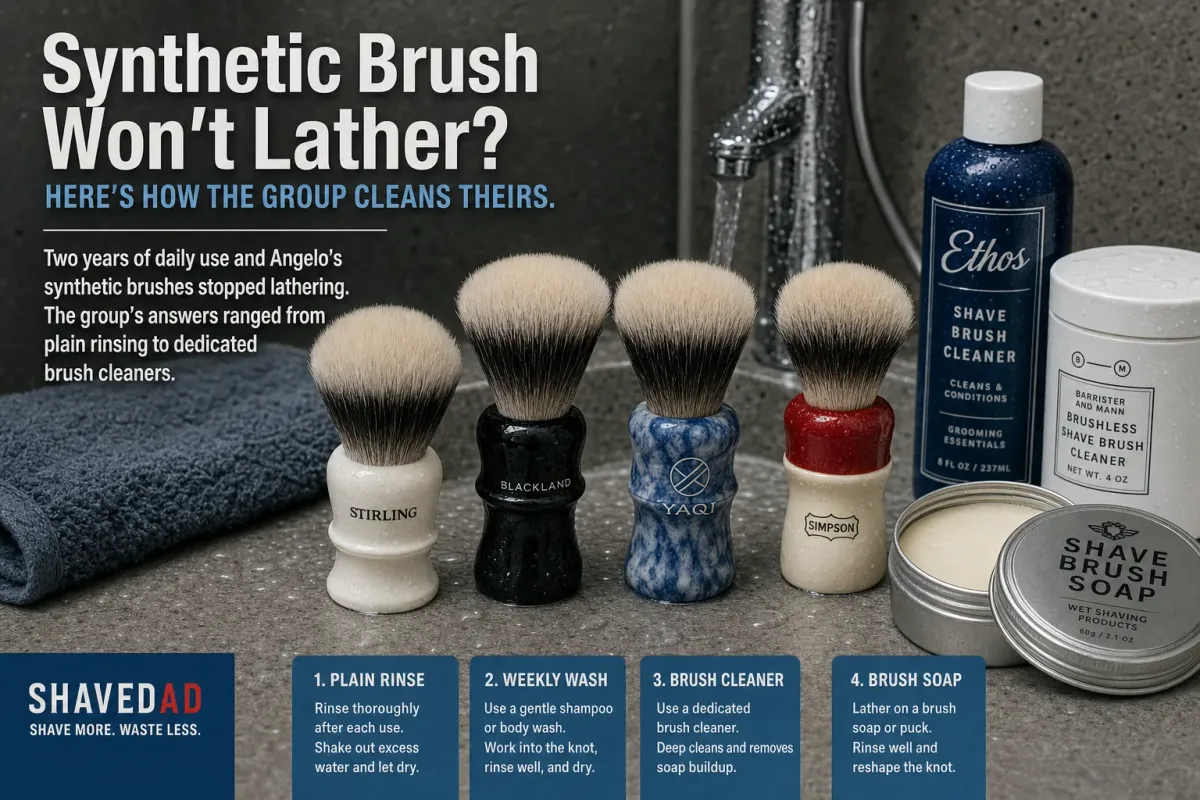
Angelo’s been running the same two synthetic brushes almost every morning for two years. No babying them, no rotation schedule, just daily use. Lately, neither one will build a lather the way it used to. He asked the group what he was supposed to be doing that he apparently wasn’t.
The honest answer, based on the thread: almost nobody agrees on one method, and a lot of guys aren’t doing anything at all.
The rinse-and-go camp
This is the biggest group by far. Timothy said it plainly: he uses shave soap on his brush, so he just rinses it out when he’s done. Michael’s never shampooed a synthetic once in his life, just water. David didn’t know cleaning a brush was even a thing people did. Adam’s only ever bothered to actually clean badger and boar; his synthetics rinse out and never hold onto funk.
That’s the whole camp in one line. No soap, no soak, no schedule. Just water, a squeeze, and a towel.
When people do reach for soap
The next tier up adds soap, but only occasionally. Wayne washes his four brushes with warm water and Dawn dish soap three times a year. Brett rinses after every use and breaks out dish soap once every couple of months. Frank doesn’t think you need anything fancy, just regular shampoo. Mike shampoos maybe once a year.
Tristan’s answer split the difference: soak in diluted vinegar if you suspect buildup, then a dish soap hand lather, then a final rinse. That’s a real deep-clean, not a maintenance step, and it lines up with what a couple other people said about vinegar being for suspected buildup specifically, not routine washing.
The dedicated brush cleaners
Then there’s a smaller group that skips the kitchen cabinet entirely. Jeff and Ronnie both use Zingari Man’s brush cleaner. Bolin does too. Tony uses it as well, and pointed out that PAA makes one too. Alex splits it by hair type: PAA brush soap for synthetics, Zingari brush cleaner for natural hair, though he admits he doesn’t clean that often either way. Dana mentioned Phoenix Shaving’s cleaner, which apparently ships with a step-by-step video on the product page.
Tony’s the one guy in the thread who treated this as a real skill instead of an afterthought. Rinsing sounds simple until you’re the one holding the brush under the tap for two straight minutes trying to get every last bit of soap out of a dense knot.
What was actually wrong with Angelo’s brushes
Angelo’s own theory is worth sitting with. He uses silicone scar gel on a healing scar every night before bed, and he thinks residue from that has been transferring to the brushes he handles right after. It’s a guess, not a confirmed diagnosis, but it’s specific and it’s plausible: silicone-based gels are exactly the kind of thing that would coat bristles and kill lather without leaving anything visible behind. Timothy suggested dish soap for exactly this kind of situation, the same method he’s used to rescue secondhand knots with unknown buildup.
If there’s a pattern worth pulling out of 19 replies, it’s this: the guys who report zero problems after years of daily use are almost all in the rinse-only camp. The ones who reach for dish soap, vinegar, or a dedicated cleaner are usually dealing with something specific, a secondhand knot, a suspected residue, a brush that’s gone stiff. Nobody in the thread is cleaning a healthy synthetic brush on a schedule and calling it maintenance.
That tracks with how synthetic fiber works. It doesn’t hold odor or shed the way badger does, so there’s less for a routine wash to actually fix. A thorough rinse and a real air-dry (not folded into a stand while still wet) handles most of it. Save the soap and the specialty cleaners for when something’s actually gone wrong, like Angelo’s.
Anyone still dialing in their lather technique in general might get more out of it from checking bloom water temperature and loading time before blaming the brush. Our guide to building a proper lather walks through that from scratch.
Frequently asked questions
Do synthetic shaving brushes need regular cleaning?
Not really, according to most of the group. Synthetic fiber doesn't hold soap residue or odor the way badger or boar does, so a thorough rinse and full air-dry after each use is enough for most people. Several members reported years of daily use with no cleaning beyond that.
What's a safe way to deep clean a synthetic brush?
A dish soap wash is the most commonly recommended method in the thread, either a quick hand lather with the soap or a short soak in diluted white vinegar first if you suspect buildup, followed by a full rinse. Do this occasionally, not as a routine.
Are dedicated brush cleaners worth buying?
Several members use Zingari Man, PAA, or Phoenix Shaving's brush cleaners and like them, but nobody in the thread treated them as necessary. They're an option for people who want a purpose-made product rather than a required step.
Why would a synthetic brush suddenly stop lathering well after years of normal use?
The most likely culprit is something coating the bristles that wasn't there before, like a lotion, gel, or other product transferred from your hands. One member traced his own issue to a silicone scar gel he applies at night, before handling the same brushes the next morning.
Happy shaving.