

How to Shave Your Head With a Safety Razor (Without Cutting Yourself)
Shaving your head with a safety razor gets you a closer, smoother result than any cartridge, for a fraction of the cost and none of the plastic. It also asks more of you than shaving your face, because the scalp is bony, curved, swirled with hair growing in every direction, and, for most of its surface, completely invisible to you while you work. None of that is a reason to avoid it. It is a reason to learn it properly, which is what this guide is for. Do it right and a full head shave becomes a ten-minute routine that leaves your scalp genuinely smooth and comfortable.
Why Use a Safety Razor on Your Head
The case is the same as it is for your face, only more so. A single keen edge cuts closer than a clogged multi-blade cartridge and does not drag stubble and skin the way cartridges do, which on a large, exposed surface like the scalp means less irritation and fewer bumps. A safety razor blade costs pennies where cartridges cost dollars, and a head shaver goes through a lot of blade, so the savings are real. And there is no plastic cartridge in the landfill every week.
The honest tradeoff is the learning curve. You cannot see the back of your head, the scalp has more grain directions than your face, and the skull has ridges and curves that change the angle every inch. The good news is that all of this is learnable in a couple of weeks, and once your hands know the shape of your head, you stop needing to see it at all.
Before the Blade: Prep Is Everything
A head shave lives and dies on prep, more than a face shave does, because you are covering a big area and cannot easily spot-check your work.
If your hair is more than stubble, knock it down with clippers first. A safety razor is for the final smoothness, not for removing length, and trying to plow a razor through real hair is how you clog the blade and tear your scalp. Get it to a close buzz, then shave.
Then soften everything. The best time to shave your head is right after a hot shower, when the skin is warm and the stubble is hydrated and standing up. If you are not showering first, lay a hot damp towel over your scalp for a minute. A pre-shave step earns its place here too: work in a pre-shave like the Proraso Pre-Shave, or a few drops of oil, before you lather, to add slickness across all that skin. Then build a good, slick lather with a brush and a quality soap and cover the whole scalp evenly. Never, ever take a dry razor to a dry scalp.
Learn Your Scalp’s Grain
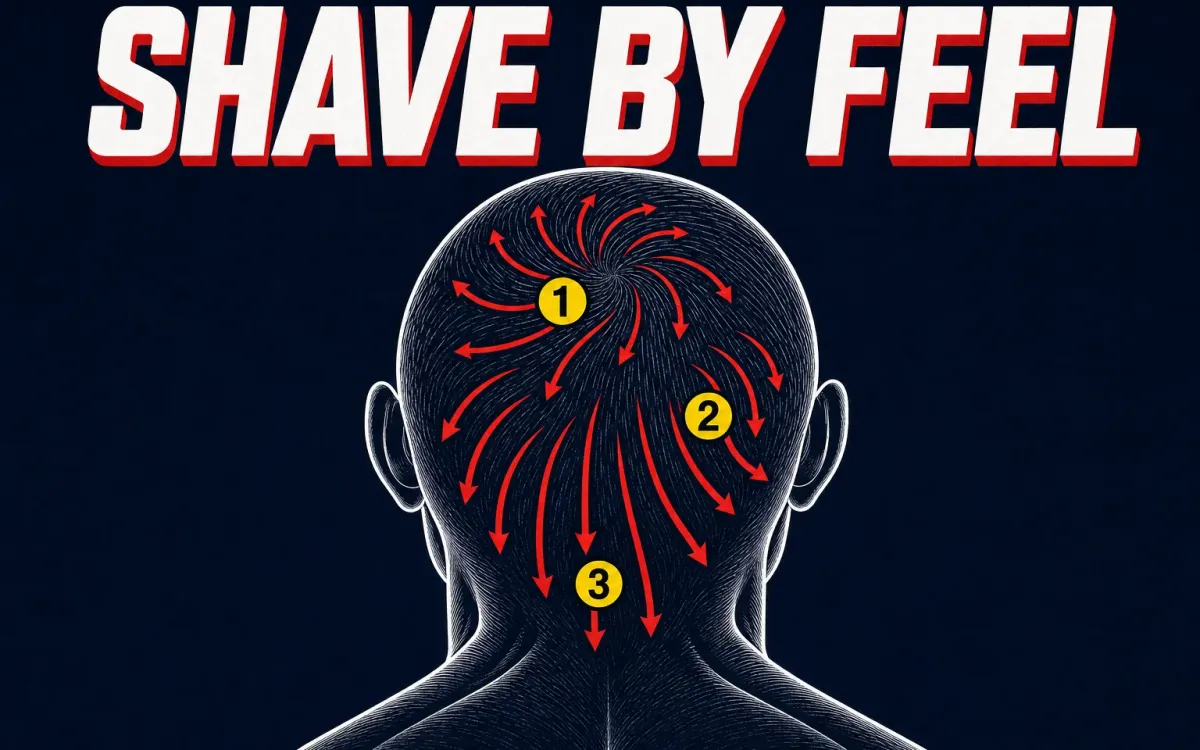
Your scalp does not grow hair in one direction, and shaving it as if it does is why beginners get bumps and miss patches. Most heads have hair that grows outward from a crown swirl at the back, sweeping down toward the neck at the base, down toward the ears on the sides, and forward or every-which-way on top. There can easily be four or five directions across one scalp.
You map it the same way you map your face: let a day or two of growth come in, then run your fingertips lightly across the stubble everywhere, feeling for the direction that is smooth and the direction that is rough. Smooth is with the grain, rough is against it. Pay special attention to the crown, where the hair spirals and the grain rotates around a point. Commit the rough map to memory, because you are going to shave much of it without looking.

The Technique: Go by Feel, Not by Sight
Here is the skill that makes head shaving click: for everything you cannot see, you shave by feel. Your non-dominant hand is your eyes. Run your free hand over the scalp ahead of the razor to find the stubble and the direction, keep a fingertip near the head to feel where you have already been, and let touch tell you what a mirror cannot.
Use short strokes, an inch or two at a time, and no pressure at all. Let the weight of the razor do the cutting and keep the blade at a shallow angle, around thirty degrees, the same as on your face. Stretch the skin flat with your free hand as you go, because scalp skin moves and a taut surface cuts clean while a slack one catches on the skull’s ridges. Rinse the blade often. And go slow. Speed on a scalp you cannot see is how you find the one spot where the skull juts out.
The Pass Plan
Reduce the hair in stages, exactly like a face shave. First pass with the grain everywhere, following your map: down at the neck and sides, and around the swirl at the crown. Re-lather completely. Second pass across the grain, which is where most of the smoothness comes from and which is far gentler on the scalp than going straight against the grain. For a lot of head shavers, with the grain plus across the grain is a perfectly smooth result and the place to stop. Only if your scalp stays calm through two passes should you take a careful against-the-grain pass for the last degree of smoothness, and keep the pressure at zero when you do.
The Tricky Spots
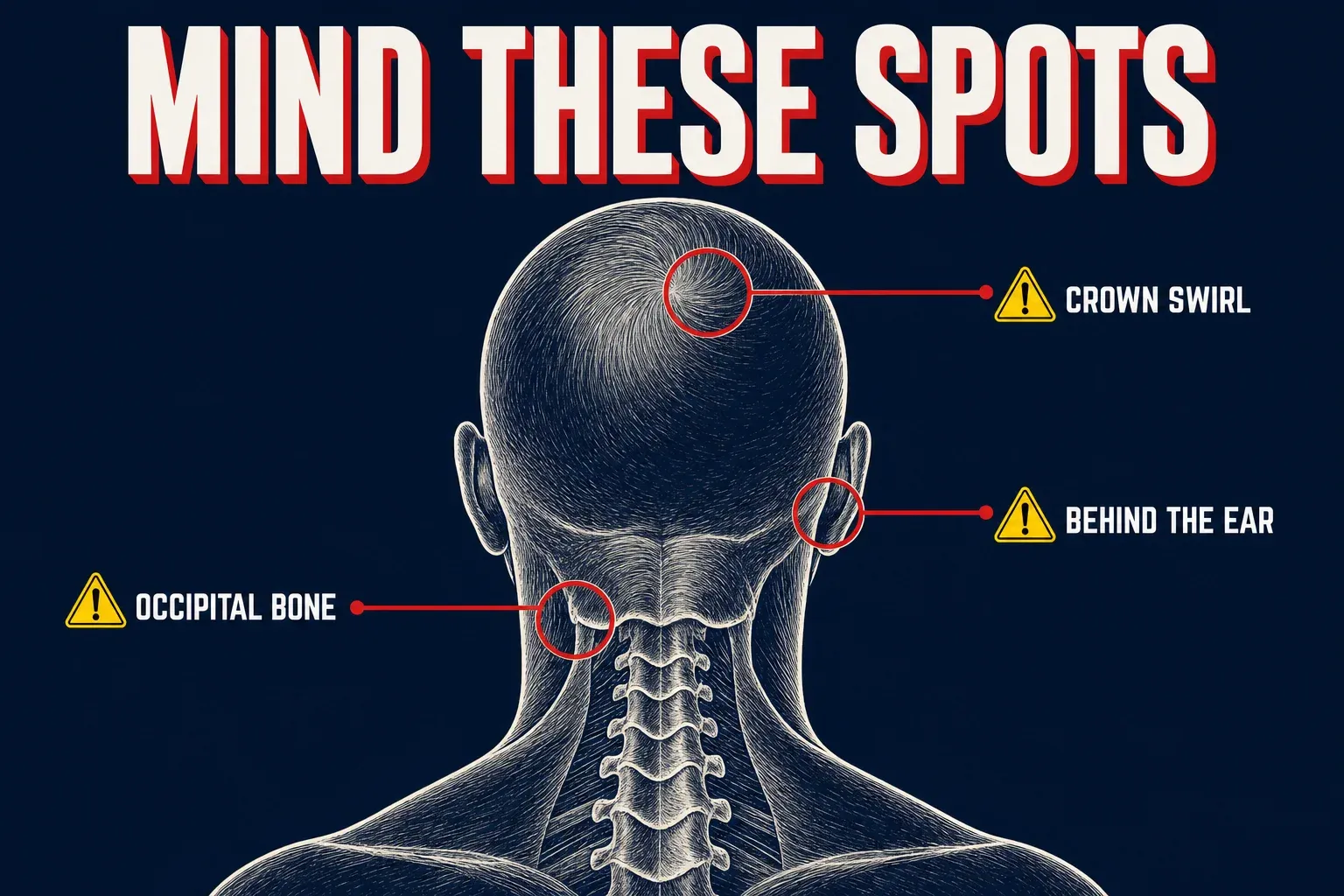
A few places on every head deserve extra care, and knowing them in advance saves blood.
The crown swirl is the hardest, because the grain rotates around a point and no single stroke direction is right for all of it. Work it in short strokes that follow the spiral, feeling your way around the rotation. The occipital bone, the ridge at the lower back of the skull, sticks out and is easy to catch, so slow down and keep the skin stretched as you pass over it. The area behind and around the ears is fiddly and full of angle changes; fold the ear down gently with your free hand and use the tip of the razor in short, careful passes. And the hairline at the back of the neck is where you blend shaved scalp into skin, so a light touch keeps it clean.
Nicks and the Scalp
The scalp is vascular, which is a polite way of saying it bleeds enthusiastically when you nick it. Do not panic when a small cut looks dramatic; it almost always looks worse than it is. Keep an alum block or a styptic to hand and press it on a nick to stop the bleeding fast. The way to avoid nicks in the first place is the same everywhere: no pressure, short strokes, taut skin, and slowing down over the bony spots. Every head shaver catches themselves occasionally, especially early on, and it becomes rare as your hands learn the terrain.
Aftercare (Do Not Skip the Sunscreen)
Rinse with cool water to close the skin down and clear the lather, then check the whole scalp with your hand for any missed patches, since you could not see them going in. Soothe the skin with a light aftershave; on a large area like the scalp a moisturizing balm like the Baxter After Shave Balm is often kinder than a high-alcohol splash, especially while your skin is getting used to being shaved.
Then the step head shavers forget exactly once: sunscreen. A freshly shaved scalp is skin that has never seen the sun, and it will burn faster than you believe on the walk to your car. If you are going outside, put sunscreen on your head or wear a hat, every single time. It is the most important part of the routine that has nothing to do with the shave itself.
The Gear You Actually Need
Nothing exotic. A mild, forgiving razor is the right choice for a surface you cannot see and cannot afford to gouge, so the Merkur 34C or the Edwin Jagger DE89 are ideal, and if you want a shop that curates a gentle starting setup, the Rockwell R1 Rookie is built to be forgiving. Pair it with a sharp but smooth blade like the Astra Superior Platinum or the Gillette Silver Blue, tested from a sampler so you know what your scalp likes. Add a brush such as the TWSS Black G5 to build lather over all that surface, a slick soap, a pre-shave, an alum block for nicks and feedback, a soothing balm, and sunscreen. That is the whole kit, and most of it lasts for months.
The Bottom Line
Shaving your head with a safety razor is a real skill, not a trick, and the difference between a bloody, patchy first attempt and a smooth ten-minute routine is entirely prep, grain mapping, and learning to shave by feel. Buzz it down, soften it, map the swirl, go slow with no pressure and a mild razor, take it in stages, mind the crown and the occipital bone, and finish with a balm and sunscreen. Give it two weeks of practice and your hands will know the shape of your head better than any mirror ever could, and the closest, cheapest, smoothest head shave available will be the one you give yourself.
Frequently asked questions
Can you shave your head with a safety razor?
Yes, and it gives a closer, cheaper, smoother result than a cartridge. The tradeoff is a learning curve, because the scalp is bony, curved, swirled with several grain directions, and mostly invisible to you while you work.
How do you shave the back of your head?
By feel rather than by sight. Your free hand is your eyes: run it over the scalp ahead of the razor to find the stubble and its direction, and keep a fingertip near the head to feel where you have already been.
Do you need to clipper your head before shaving it?
If the hair is more than stubble, yes. A safety razor is for the final smoothness, not for removing length, and plowing a razor through real hair clogs the blade and tears the scalp.
Why does a scalp nick bleed so much?
The scalp is vascular, so a small nick can look dramatic. It almost always looks worse than it is. An alum block or styptic pressed on the spot stops it quickly.
Do you need sunscreen after shaving your head?
Yes, every time you go outside. A freshly shaved scalp is skin that has never seen the sun and it burns faster than most people expect. Sunscreen or a hat is the most important part of the routine that has nothing to do with the shave itself.
Happy shaving.