

Your Neck Shave Is Bad Because You Are Ignoring the Grain Map. Fix It in Three Passes.
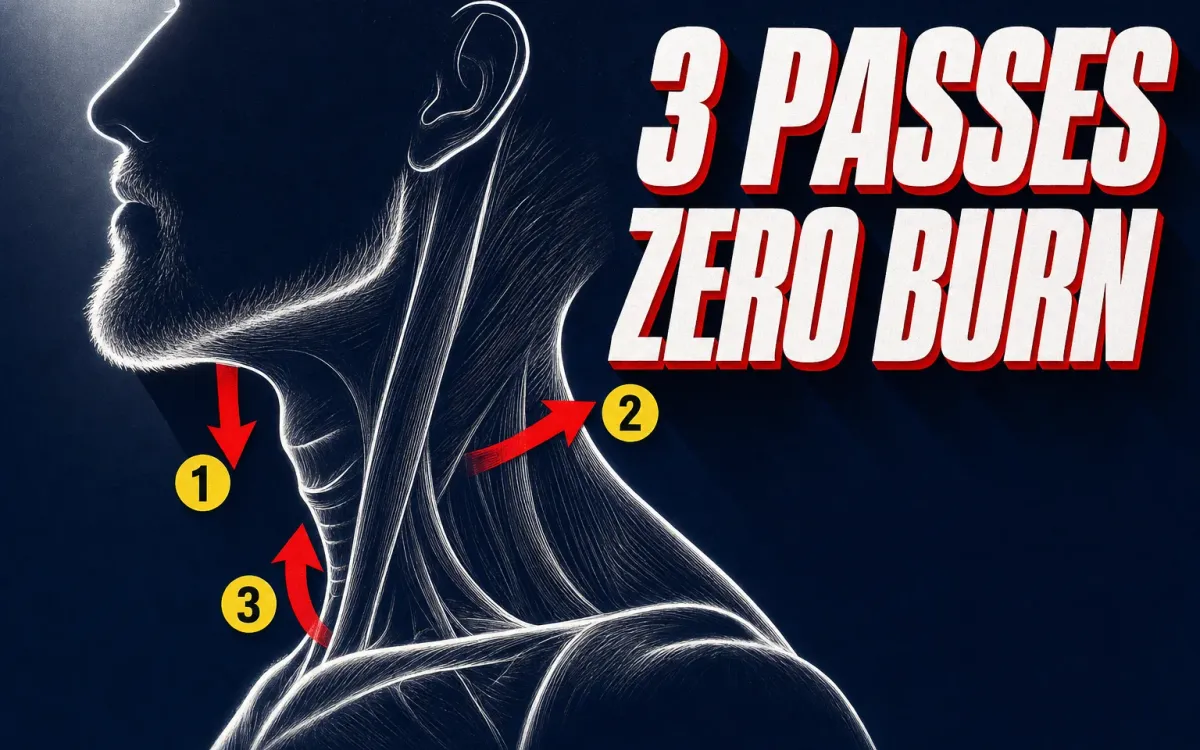
Most men who get a clean, comfortable shave on their cheeks still walk away from the mirror with a raw, bumpy neck. They blame the razor. They buy a different razor. The neck stays raw. Then they blame the blade, and the soap, and their skin, and eventually they decide their neck is just “sensitive” and learn to live with the burn.
The neck is not the problem. The problem is that you are shaving your neck the same way you shave your face, and the neck is not the face. The hair down there does not grow in one tidy direction. It grows in a swirl, and if you drag a blade straight down through a swirl, you are cutting across and against the grain without knowing it, on some of the thinnest, loosest skin on your face. That is the entire reason your neck is worse than your cheeks. Fix the map, and you fix the shave.
Why the Neck Is Different
Three things make the neck the hardest real estate on your face, and none of them are the razor.
First, the skin is thinner and looser. On the cheek, skin sits over muscle and bone with decent tension. On the neck, especially under the jaw and around the throat, it is loose and mobile, so it deforms under the blade instead of presenting a firm surface to cut against. A blade pushing slack skin is a blade that catches.
Second, the terrain is not flat. You have the shelf of the jaw, the curve down to the throat, the bump of the Adam’s apple, and the hollow beside it. Each of those is a different angle, and a razor held at one fixed attack angle cannot possibly stay correct across all of them.
Third, and most important, the hair grows in multiple directions. Cheek hair usually runs straight down in a single, readable direction. Neck hair commonly runs in three to five different directions on the same neck, spiraling around the throat, sweeping sideways under the jaw, and often growing upward toward the chin near the base. Most shavers never notice this because they never check. They assume “down” is the answer everywhere, and on the neck, “down” is frequently dead against the grain.
Map Your Grain First
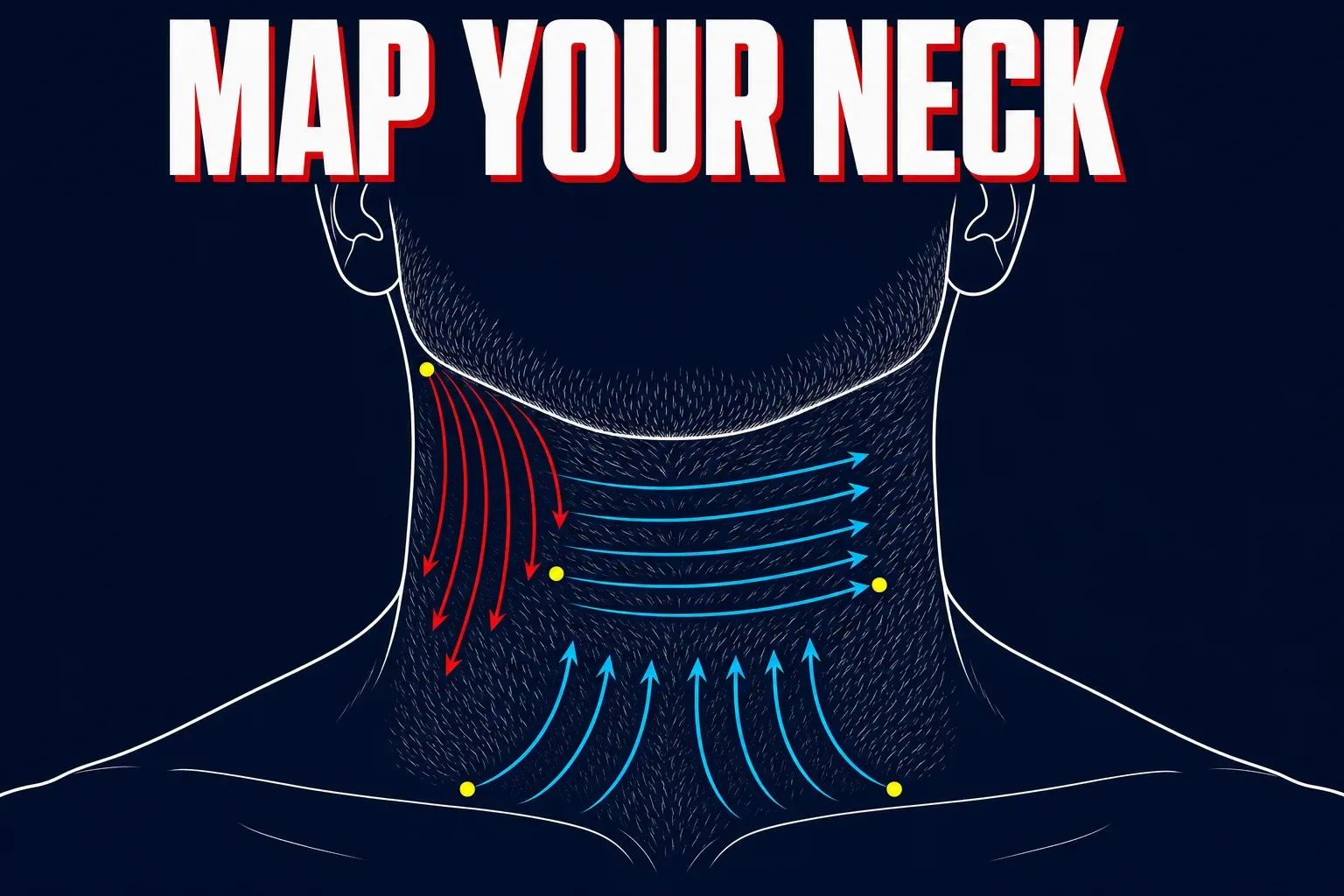
This is the single most skipped step in wet shaving, and on the neck it is the one that matters most. Before you change anything else, you are going to make a map.
Let your neck grow for two or three days until the stubble is long enough to feel clearly. Then, with clean dry skin, run your fingertips lightly across the stubble in every direction: down, up, and side to side, in a few different spots from the jaw to the base of the throat. One direction will feel smooth and offer little resistance. The opposite direction will feel rough and catch on your fingers, and you may even hear it. Smooth is with the grain. Rough is against the grain.
Do this at the left side of your neck, the right side, directly under the chin, and over the throat. You will almost certainly find that the direction changes as you move across. It is extremely common for one side of the neck to grow down and toward the center while the other side grows down and out, and for the hair right at the base to sweep upward. Note each zone. Some men sketch it on a piece of paper as a set of little arrows; others just commit the three or four zones to memory. Either way, you now know something about your own face that most shavers never learn.
With the grain (WTG) means the blade travels the same direction the hair grows. Across the grain (XTG) is perpendicular to it. Against the grain (ATG) is straight into it. Those three words are meaningless until you have the map, because “down” might be WTG on your cheek and ATG on the side of your neck. The map is what makes the three-pass method work.
The Gear That Actually Matters on the Neck
You do not need different gear for your neck than your face, but three qualities that are merely nice on the cheek become the difference between clean and raw on the neck: a mild razor, a sharp but smooth blade, and a genuinely slick lather.
A mild razor gives you a smaller margin of error, which is exactly what you want on loose skin over uneven terrain. A mild, forgiving head lets you make several light passes instead of trying to win in one aggressive stroke. The Merkur 34C is the classic recommendation here, a medium-mild workhorse that behaves itself on the neck. The Edwin Jagger DE89 is just as forgiving and shares the same reputation for a neutral, beginner-safe head. If you like the idea of dialing the aggression down while you learn your neck and dialing it back up later, an adjustable-plate razor like the Rockwell 6C lets you run its mildest plates on neck day and grow into more.
The blade should be sharp enough to sever the hair cleanly without you leaning on it, and smooth enough not to grab on that loose skin. Those are two different properties. The Gillette Silver Blue is the community’s default for exactly this balance, sharp with almost no roughness. The Gillette Nacet is a hair sharper for coarse growth, and the Voskhod is one of the smoothest blades in wide rotation if your skin reacts more to friction than to sharpness. If your neck is genuinely reactive, drop back to the Astra Superior Platinum, which is milder and about as forgiving as a blade gets. What you do not want on your neck is a dull blade, because a dull blade forces pressure, and pressure is the enemy here.
Lather is the part people underrate. On the neck you want a slick, cushioning soap that lets the blade glide over slack skin instead of dragging on it. The Barrister and Mann Seville is widely praised for its slickness and residual glide. The Italian classic Cella Crema da Barba is a soft soap that whips into an almost greasy-slick lather made for exactly this. Anything from Stirling lathers thick and protective and is easy to load heavy. Whatever you choose, build it wetter than you think and paint an even coat over the whole neck. A pre-shave step helps too; a few drops of the Stirling Pre-Shave Oil under the lather adds a layer of glide on the trouble zones before the blade ever arrives.
The Three-Pass Neck Method
Here is the method the whole post has been building toward. The principle is reduction, not removal. You are not trying to clear the neck in one pass. You are taking the hair down in stages, each pass shorter and gentler than a single aggressive scrape, and re-lathering between every one.
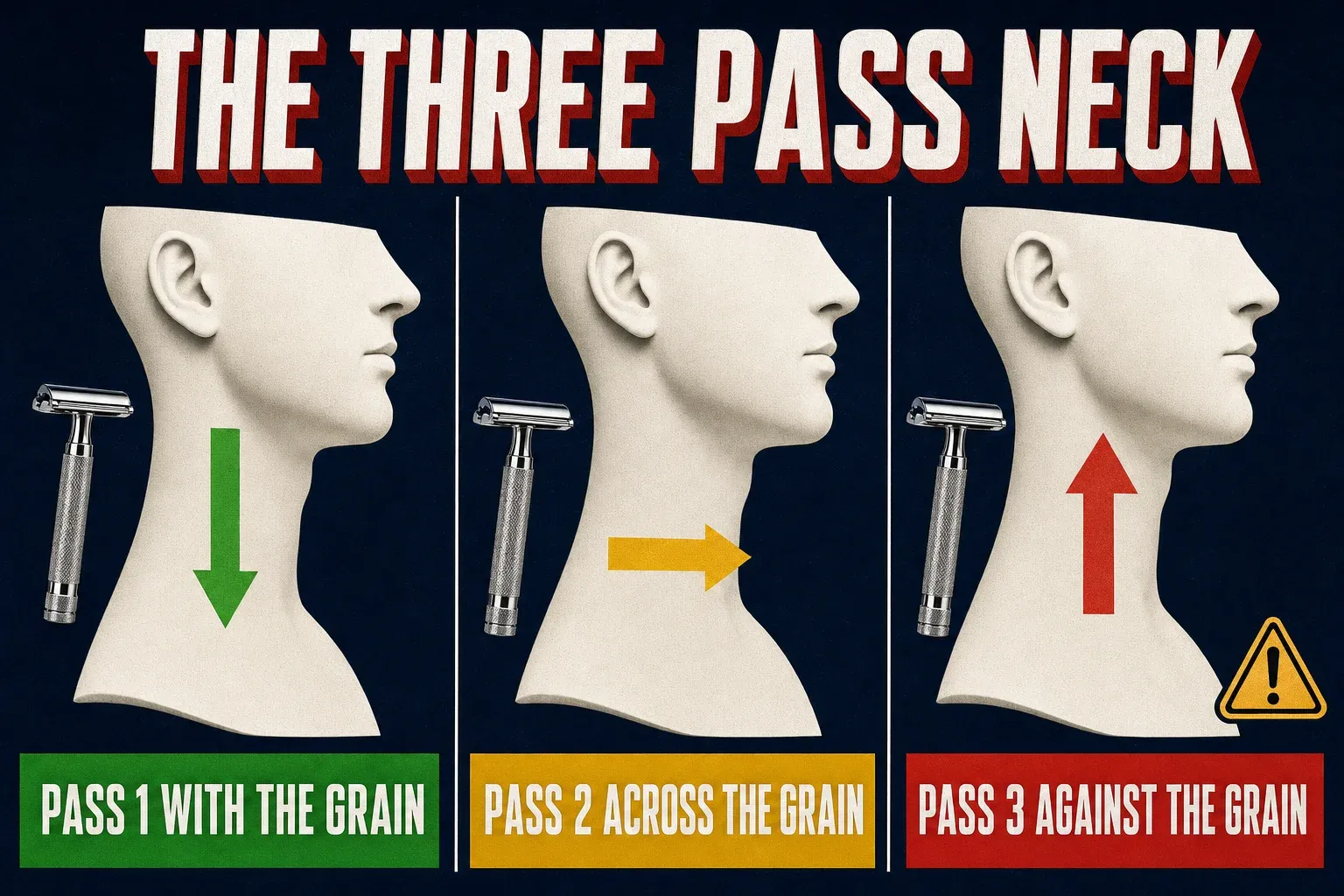
Pass one, with the grain. Lather up and shave every zone of your neck in the direction its hair grows, following your map. On the side that grows down and out, you go down and out. On the base that sweeps up, your first pass may actually travel upward, because upward is with the grain there. This pass barely feels like it does anything, and that is correct. It is knocking the length down and setting up the passes that follow. Use no pressure. Let the weight of the razor do the work.
Pass two, across the grain. Re-lather completely. Now shave perpendicular to the grain in each zone. This is where most of the closeness comes from, and it is far gentler than going straight against the grain would be. For a lot of men, with the grain plus across the grain is all the neck ever needs, and they stop here with a smooth, comfortable result and no burn.
Pass three, against the grain, only if your neck tolerates it. Re-lather again. If, and only if, your skin has been calm through the first two passes, you can take a careful against-the-grain pass for that last measure of closeness. Keep the pressure at zero, keep the strokes short, and stop the instant you feel any drag or sting. On many necks this pass is a step too far and trades a comfortable shave for a day of irritation. There is no shame in living at two passes. A smooth, irritation-free neck at pass two beats a raw one chasing baby-smooth at pass three.
Between and during passes, keep the skin taut. Use your free hand to gently stretch each zone flat before the blade arrives, because a firm surface cuts clean and slack skin catches. Tilt your head to open up the throat and the area under the jaw. And rinse the blade often; a blade clogged with lather and stubble stops gliding and starts dragging.
After the Shave
The neck wants a calm landing. Rinse with cool water to close things down and clear the last of the lather. Many shavers pass an alum block over a wet neck at this point; it gives a mild antiseptic tightness and, usefully, any spot that stings under the alum is a spot you were a little too aggressive, which feeds back into your map for next time.
Then give the skin something quiet. An unscented, alcohol-free balm settles a freshly shaved neck without the sting of a splash, and a basic sensitive-skin balm is about the cheapest good post-shave you can buy. Skip the high-alcohol aftershaves on the neck while you are still dialing in your technique, since the neck will tell you loudly if you have overdone it.
Common Neck Mistakes
A few habits quietly wreck necks, and they are all easy to drop once you know them.
Pressure is the big one. The neck tempts you to bear down because the loose skin resists, but pressure is what turns a close shave into razor burn. Let the blade’s own weight cut, and if it is not cutting, the answer is a sharper blade or a better map, never more force.
Chasing baby-smooth against the grain on day one is the second. Closeness is earned over weeks as your skin toughens and your map sharpens. Go against the grain before you are ready and the neck will punish you every time.
Not re-lathering between passes is the third. A dry or thinning lather is a dragging blade. Rebuild a full, slick coat before every pass, every time.
And going over the same spot again and again, buffing at one stubborn patch, is the fastest way to strip skin. If a patch is not clearing, it is usually a grain-direction you have wrong, not a pass you did not repeat enough. Go back to the map.
The Bottom Line
Your neck is not sensitive and your razor is not broken. Your neck grows hair in a pattern your face does not, and until you map that pattern you are shaving blind against your own grain. Spend five minutes reading your neck with your fingertips, run a mild razor and a smooth blade through a slick lather in three staged passes that follow the map, and quit while your skin is still calm. Do that for a couple of weeks and the raw, bumpy neck you thought you were stuck with turns into the easiest part of the shave.
Frequently asked questions
Why is my neck harder to shave than my face?
Three things, and none of them are the razor. The skin is thinner and looser, so it deforms under the blade instead of presenting a firm surface. The terrain is not flat, with the jaw shelf, the throat curve and the Adam’s apple each needing a different angle. And the hair grows in multiple directions, commonly three to five on the same neck, where cheek hair usually runs in one readable direction.
How do I map the grain on my neck?
Let the stubble grow two or three days until you can feel it clearly, then on clean dry skin run your fingertips lightly across it in every direction at the left side, the right side, under the chin and over the throat. Smooth with little resistance is with the grain; rough and catching is against it. The direction will almost certainly change as you move across.
What is the right way to shave your neck?
Three passes with re-lathering between each, working to reduce rather than remove. Pass one goes with the grain in every zone following your map, which may mean shaving upward at the base. Pass two goes across the grain, which is where most of the closeness comes from. Pass three against the grain is optional and only if the skin stayed calm.
Do I need to shave my neck against the grain?
No. For a lot of men, with the grain plus across the grain is all the neck ever needs. On many necks the third pass trades a comfortable shave for a day of irritation, and a smooth irritation-free neck at pass two beats a raw one chasing baby-smooth at pass three.
What gear helps most on the neck?
A mild razor, a blade that is sharp but smooth, and a genuinely slick lather. A mild head lets you take several light passes instead of trying to win in one stroke, sharpness and smoothness are two different properties and the neck wants both, and the lather needs to be built wetter than you think so the blade glides over slack skin instead of dragging.
Happy shaving.