

Safety Razor vs. Cartridge: What Five Blades Are Actually Doing to Your Face
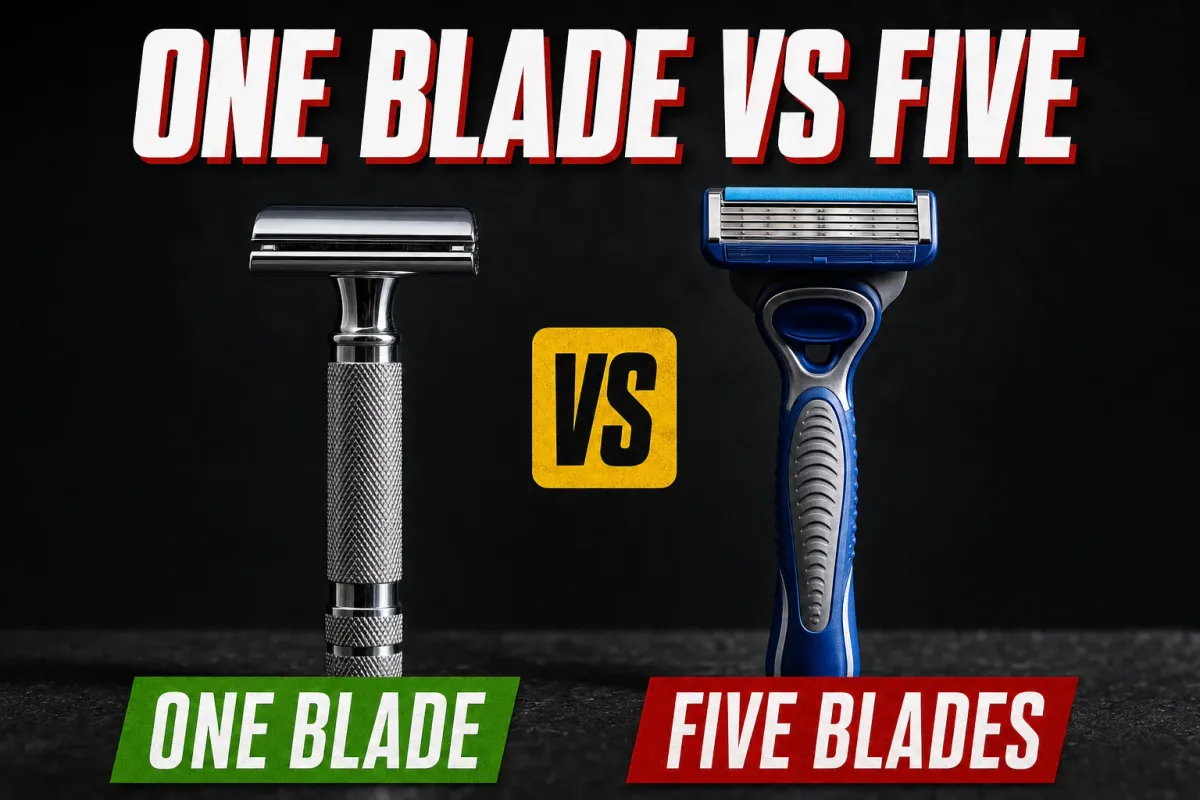
Every wet shaver gets asked the same question at some point: is a safety razor actually better, or is it just nostalgia with a learning curve? It is a fair question, because the cartridge razor was sold to all of us as progress. More blades, pivoting heads, lubricating strips, vibrating handles. Surely five blades beat one.
Here is the uncomfortable part: the mechanism that makes a cartridge feel smooth is the same mechanism that causes many of the problems people switch away from. This is not a conspiracy theory. It is how the manufacturers themselves describe their product. Once you understand it, the whole comparison snaps into focus.
The Tug-and-Cut Problem
Multi-blade cartridges work on a principle the industry calls hysteresis, and Gillette describes it proudly in their own material: the first blade cuts and gently lifts the hair from the skin, and before it can fully withdraw, each following blade cuts it again, lower and lower. When the hair finally retracts, it settles at or below the skin’s surface. That below-the-surface finish is the whole selling point. It is why a fresh cartridge shave feels so smooth.
It is also the problem. A hair cut below the surface has to grow back out through the skin, and on plenty of faces, especially with coarse or curly hair, it does not make it. It curls, catches, and grows back into the skin instead. That is an ingrown hair, and it is why the men with the most stubborn razor bumps are so often the men using the most blades. The smoothness and the bumps are the same feature.
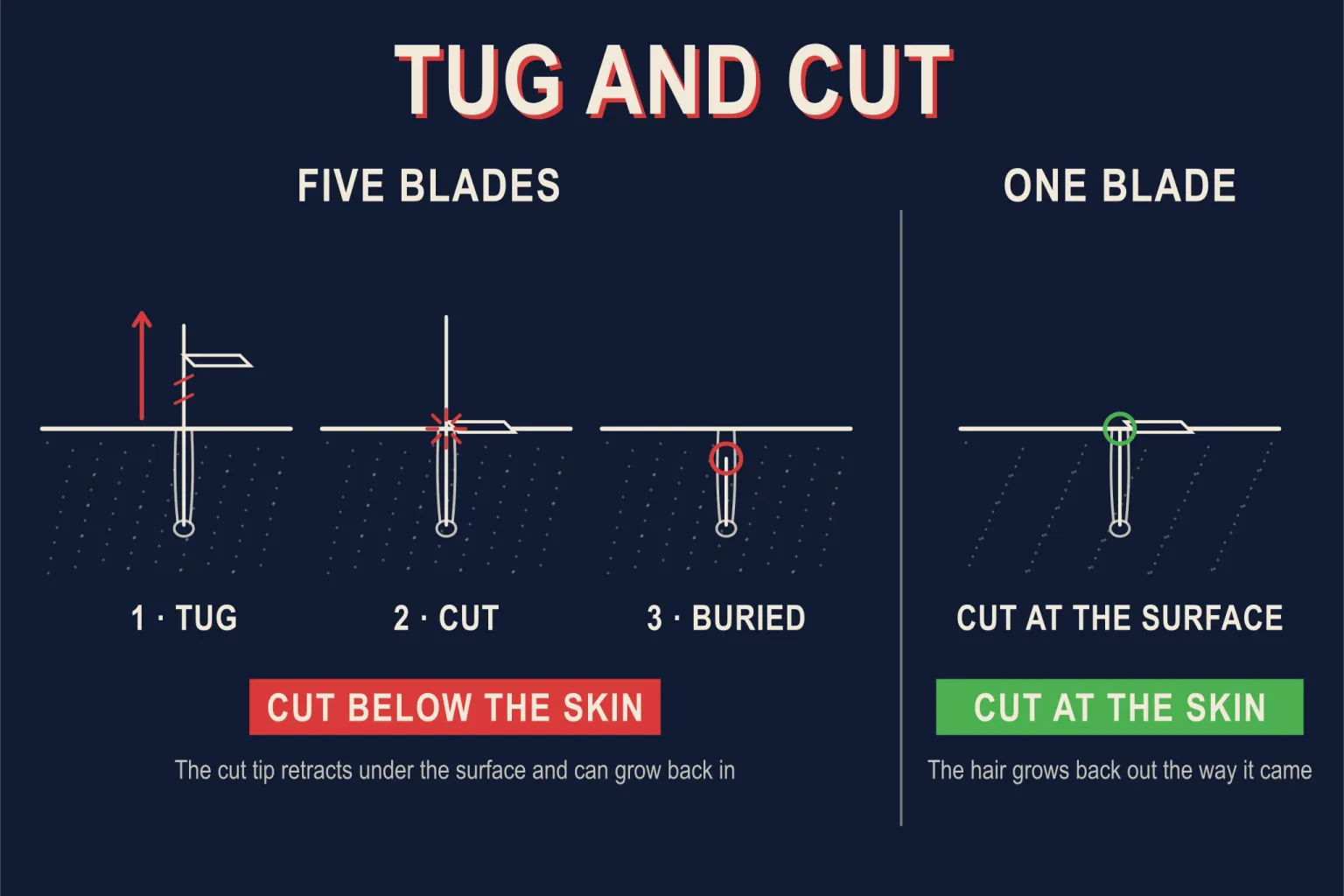
A double-edge safety razor does none of this. One blade, one clean cut, at the surface of the skin. The hair grows back out the way it came. Nothing is buried, so nothing has to tunnel. For a lot of shavers, that single difference is the whole reason ingrown hairs and razor bumps fade within a few weeks of switching.
Five Blades Means Five Scrapes
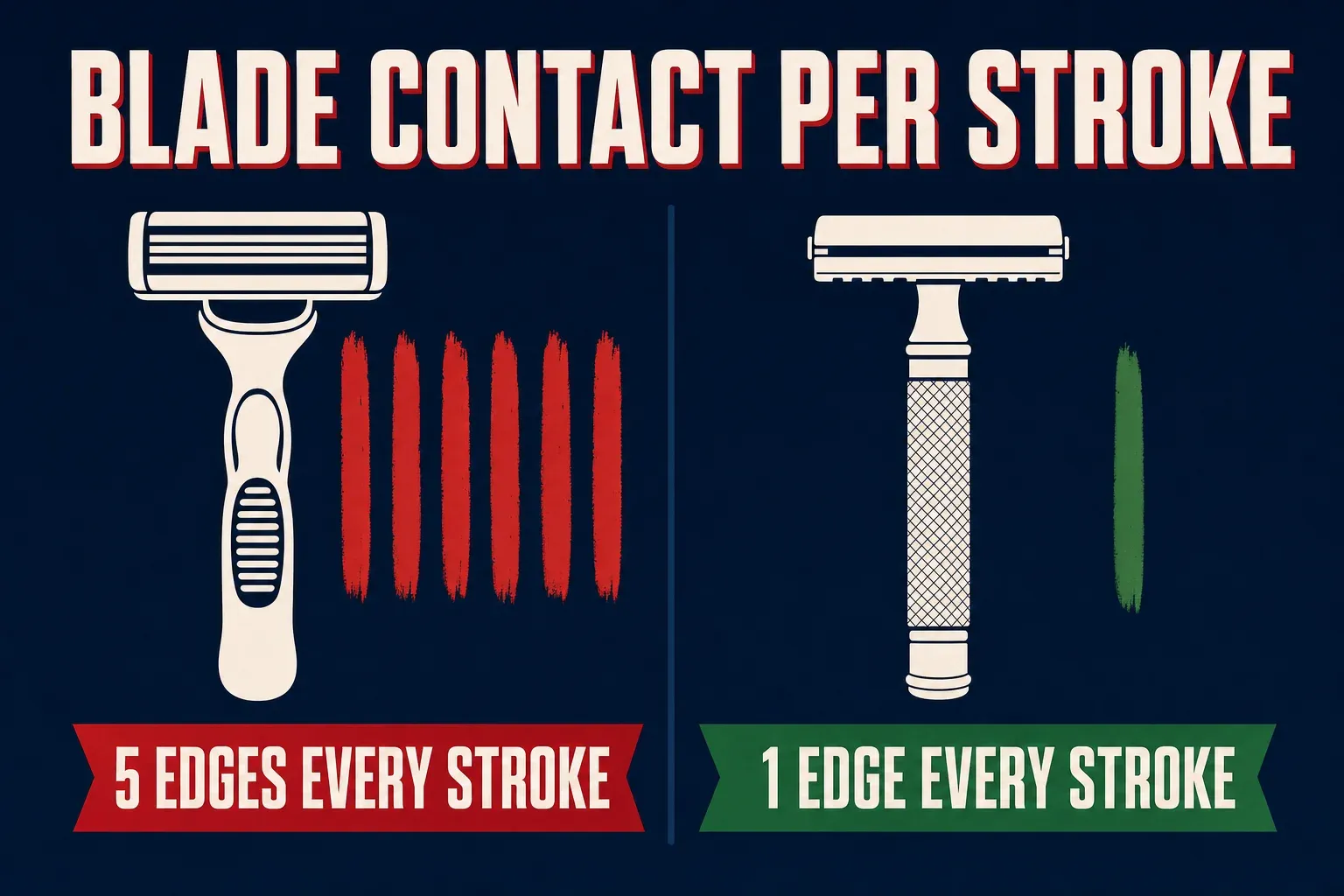
The second difference is simpler arithmetic. Every stroke of a five-blade cartridge drags five edges across your skin. Shave your neck with three strokes and that patch of skin has been scraped fifteen times. Do the same with a safety razor and it has been scraped three times.
Irritation from shaving is largely cumulative friction, so this is not a small detail. Razor burn, redness, and that tight, angry feeling after a shave scale with how many times steel crossed your skin. A safety razor gets you the same beard reduction with a fraction of the total blade contact, which is why so many people with chronic razor burn find it simply stops once they switch and learn the technique.
The Pivoting Head Works Against You
Cartridge razors pivot so you can shave fast and carelessly, and that convenience quietly teaches terrible habits. Because the head maintains blade contact for you, the only feedback you get is pressure, so people press. Pressing a five-blade head into your face multiplies everything above.
A safety razor’s head is fixed. You control the angle, and the razor’s own weight supplies the pressure, which is to say almost none. That sounds like a downside, and for the first week it genuinely is, but it puts you in charge of the two variables that actually determine shave comfort. Nobody ever fixed razor burn by pressing a cartridge harder. Safety razor users fix it every day by adjusting an angle.
What the Switch Honestly Asks of You
None of this is free, and pretending otherwise is how people end up disappointed. A safety razor asks you to learn a skill. The first week feels awkward, the second week clicks, and somewhere in the first month it becomes automatic. You will shave slower at first. You will probably nick yourself once or twice while your hands learn the angle. Our complete beginner walkthrough covers the whole learning curve step by step, and the Beginner’s Path goes deeper on every piece of the routine.
You also take on a little more ritual: a brush, a lather, two or three passes instead of one fast scrape. Most people who switch come to like that part, but if you genuinely want a ninety-second shave with zero attention, that is a real trade-off to weigh.
Where the Cartridge Still Wins
Honesty demands the other side. A cartridge is faster when speed is everything, it is more forgiving in a moving vehicle or a rushed morning, and there is no learning curve. If you travel carry-on only, blades add a wrinkle too: loose double-edge blades cannot fly in the cabin, so there is some planning involved, which our travel guide sorts out. And if your current routine gives you no irritation, no bumps, and no complaints about cost, there is no law that says you must switch.
But if you are reading a safety razor comparison at all, something probably is not working, and the most common somethings, razor burn, ingrown hairs, bumps, and the recurring sting of cartridge refill prices, are exactly the things one blade addresses. On the money side alone, the arithmetic is lopsided; we ran the full cost math and the cartridge habit loses badly to blades that cost pennies.
Making the Switch
The starter kit is short and lasts for years. A mild, forgiving razor is the whole game at the beginning: the Merkur 34C is the classic recommendation, the Edwin Jagger DE89 its equally gentle rival, and the Rockwell R1 Rookie is purpose-built for the learning curve. Add a sharp, smooth blade like the Astra Superior Platinum, a simple synthetic brush such as the TWSS Black G5, and a beginner-friendly soap like Proraso Green. Our honest beginner razor shortlist goes deeper if you want the full reasoning.
Give it a month of with-the-grain, no-pressure shaves before you judge. The skin problems the cartridge created took years to build; give one blade a few weeks to undo them.
The Bottom Line
The five-blade cartridge buys its smoothness by cutting hair below the skin and dragging five edges across your face to do it, and that is precisely where ingrown hairs and razor burn come from. A safety razor cuts once, at the surface, under your control. It asks a week or two of patience and pays you back with calmer skin and blades that cost pennies. That is the whole comparison, and it is why this hobby keeps growing a century after the cartridge was supposed to have replaced it.
Frequently asked questions
Is a safety razor better than a cartridge razor?
For most people with razor burn, ingrown hairs, or bumps, yes. A cartridge cuts hair below the skin surface by design, which is where ingrown hairs come from, and drags five edges across your skin every stroke. A safety razor makes one clean cut at the surface with a single edge. The trade is a week or two of learning curve.
Why do cartridge razors cause ingrown hairs?
Multi-blade cartridges use tug-and-cut: the first blade pulls the hair up and the blades behind cut it while stretched, so it retracts below the skin surface. A hair cut below the surface has to grow back out through the skin, and especially with coarse or curly hair it can curl and grow back in instead.
Do safety razors cause less razor burn?
Generally yes, once technique settles. Shaving irritation is largely cumulative friction, and every cartridge stroke drags five edges where a safety razor drags one. Three strokes over your neck means fifteen scrapes with a cartridge versus three with a safety razor.
How long does it take to switch to a safety razor?
The first week feels awkward, the second clicks, and within a month it is automatic. Shave with the grain using no pressure while you learn, and judge the switch after a few weeks, not after the first shave.
What do you need to switch from cartridges to a safety razor?
A mild razor such as the Merkur 34C, Edwin Jagger DE89, or Rockwell R1 Rookie, a sharp smooth blade like the Astra Superior Platinum, a synthetic brush, and a beginner-friendly soap. The kit lasts for years and the blades cost pennies.
Happy shaving.